


Editor’s note: This story is part of a three-part series examining the impact of data centers on local communities.
COUNCIL BLUFFS, Iowa — Nearly 20 years ago, Google Inc. chose this agricultural and frontier community to build its first hyperscale data center campus in Iowa, on the site where Council Bluffs Drive-in Theater stood for nearly 50 years. If drive-in theaters once represented cutting-edge technology in cinema, Google was innovating at the speed of business with its free search engine and emerging cloud-based software.
About 600 hyperscale data centers operate in the United States. Hyperscale data centers are generally defined as buildings over 10,000 square feet and require more than 100 megawatts of electrical capacity.
Nearly two decades after it first broke ground in Council Bluffs, Google’s impact extends beyond its massive buildings and computing power. Its operations process online services such as YouTube, Google Search, Gmail and Google Maps. Its presence now powers nearly $672 million in annual economic activity and supports more than 2,500 jobs across the Omaha metropolitan area. But data centers also bring significant demands on communities, including proposals that can require 1 million to 2 million gallons of water a day. The experience in Council Bluffs gives other communities considering data centers a real-world look at whether the promised benefits outweigh the costs over time.
That’s why I traveled to this western Iowa outpost recently. I have spent months watching other Midwestern communities wrestle with hyperscale data centers largely in the future tense — what they might bring, how much power and water they might consume, whether the promised economic benefits will materialize and what communities might sacrifice in return.
Council Bluffs offers something that hundreds of communities considering or awaiting data centers don’t have ― nearly two decades of evidence about the economic, environmental and community tradeoffs that come with living alongside one. In that time, Google has built centers with 600 megawatts of computing power, roughly the average electricity demand of 500,000 homes if equipment is running at full capacity at any given time.
I learned a lot, and that included correcting some preconceived notions about what I would find.
A transportation crossroads
Founded in 1853, Council Bluffs (population 62,600) sits on the east bank of the Missouri River across from the gap-toothed, modern skyline of Omaha, Nebraska, and its new and shiny 44-story Mutual of Omaha tower. President Abraham Lincoln designated Council Bluffs as the eastern terminus for the first transcontinental railroad in 1863.
Downtown Council Bluffs is pretty and quaint with mid-19th century mission-style architecture coexisting with that found in almost any Main Street in America: ornamental trees, up-to-date building facades and thick older hardwoods that have seen plenty of history.
Historic homes, including that of frontier Union Army Gen. Grenville M. Dodge, sit on a bluff overlooking old downtown. The suburbs look like Anyplace USA, with big-box retailers like Target, Walmart and fast-casual restaurants like Texas Roadhouse and Chipotle.
Two riverboat casinos opened here in 1996. Now they operate on land as Horseshoe and Harrah’s, along with a big meeting space that welcomed Vice President J.D. Vance in September. He came to town to rally farmers and campaign for GOP candidates running for local and national office. Tom Hanafan River’s Edge Park is first-class, a popular gathering place along the Missouri River with a 5-acre lawn, an amphitheater and a pier.
Google’s first data center on Veterans Memorial Highway started as a roughly 100,000-square-foot facility (about half the size of a Walmart Supercenter) before expanding as a campus. From ground-level, the facility is mostly obscured by mature greenery. Its operation emits a low hum that is no more apparent than the industrial noise surrounding it. Neighbors include a Casey’s convenience store, FedEx and Amazon distribution facilities.
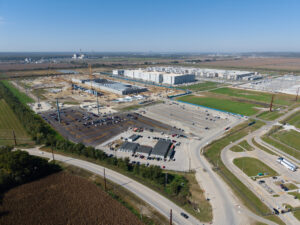
Today, about four miles southeast of downtown, Google construction continues on its second data center campus, Google Southlands, along Bunge Avenue, where traffic rumbles both ways all day long. Workers in hard hats and neon vests visit Casey’s convenience store minutes apart for gas, snacks and energy drinks.
The unique insight Council Bluffs offers on hyperscale data centers can provide a layer of clarity for communities seeking answers. Advocates believe the United States need more big data centers to remain competitive with other countries, including China. Increasingly, though, states are moving to halt data center expansion, citing environmental, land use and ethical concerns.
In August, Michigan lawmakers introduced a bill that would require data center operators to report annual water and electricity use or face a $10,000 daily penalty for noncompliance. There are over 440 enacted moratoriums affecting 46 states and more than 200 local governments, according to Interconnected Capital, a global AI investment firm.
Meanwhile, ethical concerns about the rapid advancement of AI enabled by data centers have taken on more urgency. After White House meeting earlier this fall with tech executives on the issue of safety standards and best practices, President Donald Trump announced an AI accord signed by companies pledging to self-police their technology’s potentially harmful effects.
From Old Downtown to Google Southlands
I spent two and a half days in Council Bluffs. The city is suited for those who want a slower pace while having access to good restaurants, entertainment and a Minor League baseball team in Omaha, which also hosts the College World Series.
I visited Legends Cafe, a downtown staple, where regulars conversed over eggs, bacon, potatoes and coffee. I sat with two retirees from Mutual of Omaha, who try to meet up at least once a month. They told me they like that Council Bluffs still feels small and welcoming, even against the backdrop of development. A manager of a suburban shoe store told me that because Google is here, her “blue-collar” electrician father did not have to leave town to find work.
Of course, there is another side to progress.
Geese don’t stop here anymore
Art and Shawna Caigoy purchased farmland in Council Bluffs in 1996. The place was an ideal spot for her to raise her Arabian horses. About 10 years later, Google began to build its first data center near the couple’s property, separated by several acres of easement.
“I used to be able to ride my horse and see nothing but green fields of either corn or soybeans next to us before Google came, causing the traffic to triple and causing noise and dust and constant lights starting a few years ago,” Shawna Caigoy told me. “We have slowly watched the wildlife disappear that we so loved. Geese used to stop here while heading south for winter in our pastures, but in the last several years that has stopped as Google has expanded more and more south next to our property.”
Caigoy said she was not aware of Google’s affiliation with the adjacent property until a year after the deal was completed because the purchaser was registered as Questa LLC. The Washington Post in 2019 reported Questa as one of several “shell companies” affiliated with Google in confidential business negotiations. (Another Google-affiliated company, Tetra LLC, purchased Google’s original site in Council Bluffs on Veterans Memorial Highway.)
Caigoy said her family chose to keep the property even as Google has continued to expand because of the property’s value, its proximity to Omaha and Offutt Air Force Base, where her retired veteran husband has access to critical health care.
Even though Council Bluffs Mayor Jill Shudak would not talk to me about data centers, she has not been quiet in public.
She proposed a moratorium this summer that would have halted any new data center projects for up to a year to allow the city to examine whether its infrastructure and regulations could keep pace with the industry’s extraordinary appetite. The city council unanimously rejected Shudak’s proposal as anti-development.
Such a moratorium would tag Council Bluffs as a community no longer open for business, councilman Doug Rew said.
Another hyperscale data center operator, Edged, recently announced the completion of two buildings that will house a hyperscale data center in Council Bluffs, each spanning around 285,445 square feet with a combined 200 megawatts of capacity.
A homegrown economic developer
Few individuals in the region can speak with as much firsthand knowledge and expertise about economic development in southwest Iowa as Paula Hazlewood, chief executive officer of Advance Southwest Iowa Corporation, or ASIC.
Although she grew up approximately 30 miles east of Council Bluffs, Hazlewood spent considerable time there because it is where her mother was born and raised. Hazlewood spent 10 years living in Northern Virginia, where she met her husband, a Marine stationed at Quantico.
The couple relocated to central Texas, her husband’s home region, before returning to southwest Iowa in 2001. While attracting new businesses and investment is a central focus of her role, Hazlewood told me the economic and community impact of Google’s presence in Council Bluffs will have a long-term positive effect.
“Council Bluffs has evolved into a significant employment center within the greater Omaha metropolitan area,” Hazlewood said. “While many of our residents live and work in Council Bluffs, our workforce extends well beyond city limits, drawing talent from communities within a 60-mile radius.”
She said Council Bluffs has emerged as a major employment destination and economic driver — not merely a bedroom community of Omaha.
A new economic impact study offers several proof points. The Greater Omaha Economic Development Partnership conducted an internal analysis at the request of ASIC to examine Google’s economic impact on Council Bluffs and the broader Omaha metropolitan area.
Some key findings show that Google’s presence generates an estimated $227.5 million in labor income across the Omaha metropolitan area, supports an estimated 2,569 jobs, mostly in construction, and powers approximately $671.9 million in annual economic activity.
Google has also provided laptops to Council Bluffs students and in 2024 contributed at least $1.3 million to 47 erosion-control projects across western and southern Iowa. Those projects were designed to reduce runoff and improve water quality flowing toward the Missouri and Mississippi rivers.
Google, she said, has also quietly become part of Council Bluffs. “They have done many community-minded things,” Hazlewood told me. “They’ve done it really in the background.”
A basic tradeoff
The debate over data center expansion reflects a basic tradeoff. A data center campus can occupy thousands of acres and represent billions of dollars in private investment and residual regional economic development. Yet, there are other concerns.
During a public hearing, Council Bluffs Public Works Director Matt Cox said data center proposals can seek 1 million or 2 million gallons of water per day. One million gallons is roughly the daily water use of 12,000 people. The resulting burden on a wastewater treatment plant can feel like that of 4,000 homes.
Those comparisons are not interchangeable, of course, as drinking-water use and wastewater flows depend on industrial processes, conservation and treatment systems, but they show why the numbers matter.
Cox warned that one or two projects could push the city’s system to capacity. That’s not taking sides for or against economic development. That’s math.
Hazlewood said that Council Bluffs has advantages that other communities do not have, including an abundant water source from the Missouri River, America’s longest. Local energy provider MidAmerican Energy has not raised consumer energy rates in more than 10 years, she said. MidAmerican Energy officials have publicly stated that data center customers pay dedicated interconnection and infrastructure costs and sign long-term contractual agreements. That keeps prices down for consumers. While the company has not officially raised rates, consumers may be subjected to fee adjustments in their bills.
After driving around this community and seeing the physical scale of what Google has built and continues to build, I now see more gray than black and white in the Great Data Center Debates.
Core arguments look something like this: Build them or ban them. They represent economic progress or they hurt the environment. Data center-driven AI enhances the way people live and work or it will lead to their demise.
With 20 years of proof points, Council Bluffs’ experience suggests a more nuanced reality. In 2006, when the general public was just beginning to learn about data centers, Council Bluffs, eager to grow industry, for economic, welcomed Google into the community with not much input from the general public. Things are different now, and communities can interrogate decision-making in the sunlight instead of learning of backroom deals having been negotiated after the fact.
Meanwhile, if hyperscale data centers represent the next industrial revolution, what should communities demand in exchange for the land, electricity, water and public infrastructure data centers require?
The eyeball test and the numbers suggest Council Bluffs made a pretty good decision, though not without ongoing discomfort, like that experienced by the Caigoy family, and not without new concerns — like those being raised by Mayor Shudak.
Notably, as recently as October, the city is questioning whether it can recoup $4.3 million from Google in utility franchise fees statutorily paid to Council Bluffs by anyone who uses power. That money was lost in 2024 because of a deal that capped what Google pays at 2%. Mayor Shudak said that deal was illegal.
At risk of stating the obvious, all points of view in this debate have merit, and it is up to each community to make informed decisions about what they want their future to look like — with or without a data center.
Moving forward, community leaders should be transparent with citizens and level up negotiating prowess. In other words, don’t give away the store.
Anyone who has been around me long enough knows what I think about data center communities. If you say yes, that deal should come with a “chicken in every pot,” as former Louisiana populist governor Huey Long once liked to say. They should have the best-funded schools, housing, health care, community amenities and infrastructure in the country.
Know everything and understand everything about the deal before it is final, because there’s no turning back from billions of dollars in investment and infrastructure once the data center horse is out of the barn.
Byron McCauley is Michigan columnist for USA Today Co. Email: bmccauley@usatodayco.com. @byronmccauley on all social media platforms.
This article originally appeared on The Holland Sentinel: Exclusive: What 20 years of Google taught a data center town | Opinion
This article originally appeared on The Detroit News: What 20 years of Google taught a data center town | Opinion
Reporting by Byron McCauley, Holland Sentinel, USA TODAY / The Detroit News
USA TODAY Network via Reuters Connect

What 20 years of Google taught a data center town | Opinion added by admin on
View all posts by admin →