

By: Joseph Poulos
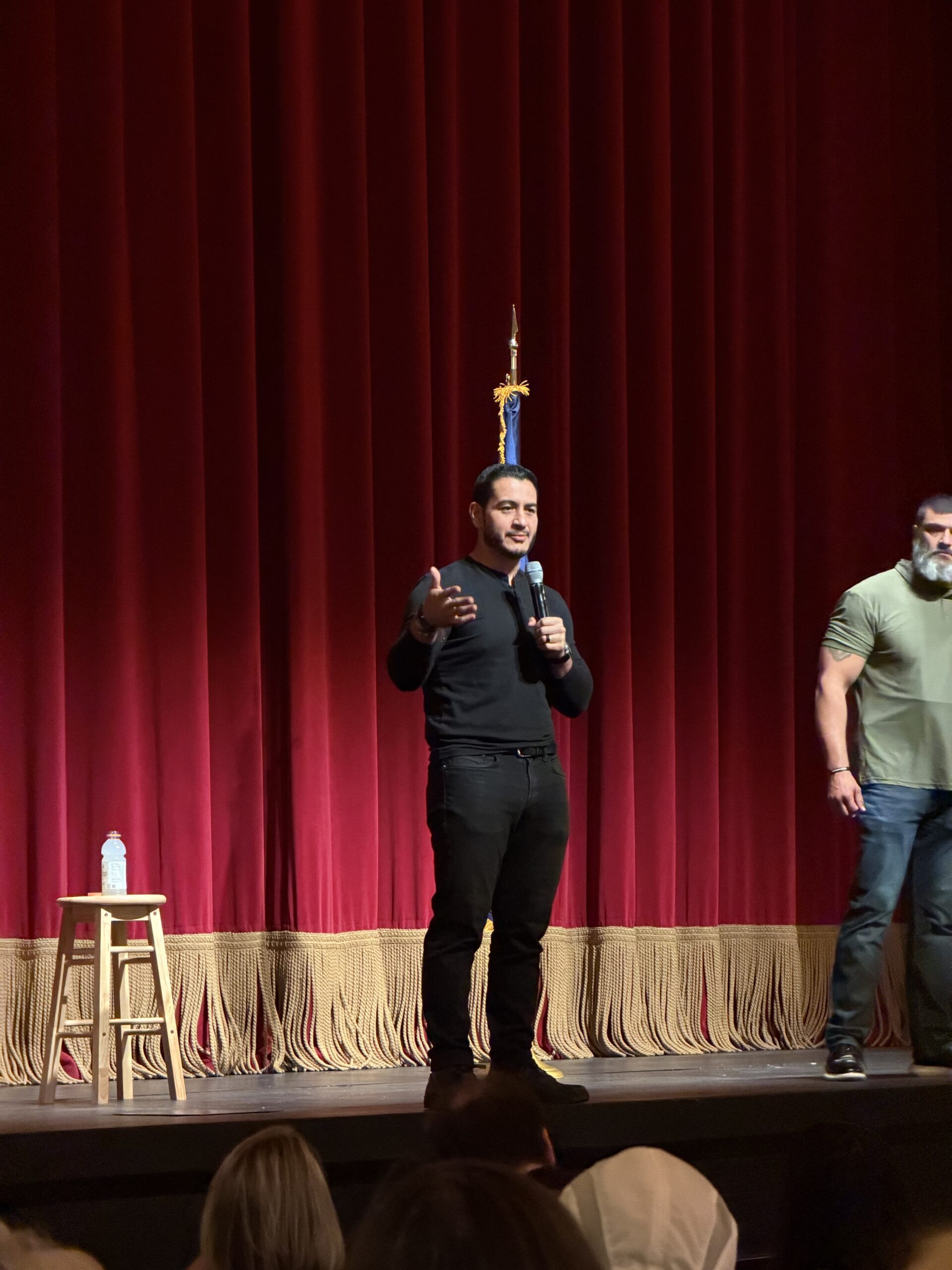
As Abdul El-Sayed stepped into the Frauenthal Center in downtown Muskegon, the roar from
the crowd made it immediately clear why national political observers are suddenly fixated on a
former county health director turned U.S. Senate hopeful.
Donning an all-black outfit and with a mic in hand, he raised his fist as he spoke, mirroring his
iconic pose from the campaign ads everyone has seen for the past two months. The crowd
response was electric.
After engaging in a brief chant with the crowd highlighting his Medicare for All platform, he
turned his attention to the audience directly:
“Thank you so much for showing up for our democracy,” El-Sayed said. “It’s in the 70s and the
sun is out. And you all chose to show up in a dark room in the middle of the day instead of
enjoying one of these last beautiful days we are going to get for a while. You did it because you
understand that the only way to make sure that the sun shines into what’s going on in
Washington, D.C. is to show up here today!”
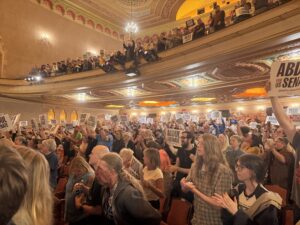
Before the rally, hundreds of excited Muskegonites wrapped around the block, talking quickly
and loudly amongst themselves. Their attention was on Abdul.
But the positive tone of the crowd isn’t the only type of response that he has garnered. The
previous night, at a campaign stop in Hart, Michigan, agitators armed with crosses and SWAT
shields disrupted the event.
In an exclusive interview with the Muskegon Tribune, El-Sayed spoke about the spotlight.
“Unfortunately, Donald Trump and JD Vance have chosen to try to make me the main character
of the midterms,” he said. “They’ve tried to incite a pushback by saying my name or pointing to
my faith.”
Just over the border in Ohio, Trump referred to El-Sayed as a “jihadist” at a rally of his own.
“The president said some really vile things about me over the course of the last couple months,”
El-Sayed said. “They’ve pointed a lot of attention on me, but I also understand that in politics,
attention means that you can point to the big issues. While they’re pointing to my name and my
faith, I’m going to be pointing to the fact that we can’t afford our gas or our groceries, and we’re
worried about the ability to see the doctor in the richest, most powerful country in the world.”
This message seemed to resonate with the citizens in attendance, who held up pro-Abdul signs
and made such a raucous racket that he had to take strictly defined pauses in between
statements to be heard clearly.
“I’m going to keep the focus on the issues, and they can stick to fear-mongering,” El-Sayed said.
“Michiganders are earnest. They want what’s best for themselves and their families. They’re not
going to be distracted by a few small people. Instead, they’re going to be looking for the
opportunity to come together to actually take on the challenge that we face together.”
The issues that face the country are myriad, and deeply rooted in economic woes, but it doesn’t
stop at the grocery store or at the gas pump. El-Sayed’s flagship philosophy of Medicare for All
is particularly enticing to voters in a country where, according to data from the Kaiser Family
Foundation, 41% of households are currently in medical debt of some kind.
“Things have just gotten so much harder for people when it comes to healthcare,” he said. “Our
premiums are up, our co-pays are up, our deductibles are up. People are falling into medical
debt left and right. They’re having to call their insurance companies and fight for insurance that
they already paid for every month.”
El-Sayed’s plan would grant Medicare coverage for all Americans, and this idea has generated
significant controversy. Lately, as healthcare costs skyrocket, more voters have seemed to jump
on the El-Sayed bandwagon.
“I think the public has shifted tremendously,” he said. “They understand that the private health
insurance industry is part of the problem, not part of the solution. They want change. I think
we’re seeing that in polling and we’re seeing that in this race here.”
As far as the logistics of such an idea go, it’s easy to understand why some would be
apprehensive. After all, how will the doctors get paid for services when the private-paid model
disappears? Taxes would be needed to fund the program, which was a great concern of
opponents to President Barack Obama’s Affordable Care Act in 2010.
“We already pay 19 cents on the dollar for every dollar spent in our economy on healthcare,”
El-Sayed said. “In other places where they have done this, they spend substantially less, and
they live longer on average than we do, right? So I think we can take a lot of the overhead off
the top of our healthcare system immediately under Medicare for All.”
His point is simple: without private insurance being deducted from your paycheck, you would
take home more money. With the American government acting as the negotiator for medical
rates rather than the average citizen, one would think that there would be a better deal to cut.
When the overhead of health insurance CEO salaries disappears, the care would be cheaper to
fund.
“The cost of the systems would go down substantially,” he said. “Meaning that you end up
paying less for more. I think that’s exactly what we want. And more importantly, it’s more
durable, meaning you don’t lose it if you turn 26 or get married or divorced or get a job or lose a
job or turn 65.”
Still, some are concerned that healthcare providers and doctors may not want to participate in
the new plan if it becomes less lucrative for them. El-Sayed drew on his own medical
background to provide a nuanced perspective.
“Right now what’s happened is that we’ve seen the inflation in healthcare disproportionately
benefit hospitals and clinics and not doctors,” he said. “Doctors’ salaries have not kept up with
what they were in the 90s when you adjust for inflation. Meanwhile, the amount of money taken
off the top of our healthcare system by the healthcare corporations has only skyrocketed. And
right now, if you’re a private practice doctor and you want to be able to provide quality care, it’s
very difficult to work outside of a healthcare system because the current approach benefits the
big hospital corporations who can negotiate sweetheart deals with the insurers. So I actually
think doctors would do a lot better under Medicare for All because they wouldn’t have to worry
about being out-negotiated by large health systems and could open up their own businesses
again and succeed and compete.”
It has always been the claim of the El-Sayed campaign to focus on policy, but after his debate
with Republican Mike Rogers on Oct. 8 in Grand Rapids, it is clear that political theater and
personal animosity may threaten to take attention away from the changes that each candidate
intends to make if elected.
“The problem, of course, is that my opponent is less interested in policy because he has nothing
to stand on when it comes to his backing of the Iran war and the tariffs,” El-Sayed said. “So he
tries to make it personal. I’m less interested in the personal; I’m a lot more interested in policy.
So, I hope it’s just like coming into the last debate that we can keep the focus on policy. Maybe
he’ll come with something. I mean, the first one he didn’t even show up to.”
With the mid-term elections looming in less than 20 days, all campaigns are looking to shore up
support in key regions. On Saturday, Oct. 24, in Detroit, El-Sayed is set to take the stage with
another man who has attracted attention of all kinds from both sides of the aisle: former
President Barack Obama.
“It’s one of those bucket list moments,” El-Sayed said. “I’m really just grateful for his support in
this race, and grateful for him, coming out to Michigan and rallying with us. I’m really looking
forward to it.”
The next debate between Abdul El-Sayed and Mike Rogers is set to take place on Oct. 21 in
Detroit as well.
The Muskegon Tribune reached out to Mike Rogers’ campaign but did not receive a response.

The ‘Main Character’ of the Midterms: An Exclusive Interview with Michigan Democratic Senate Nominee Abdul El-Sayed added by admin on
View all posts by admin →