
What to know about voting in Michigan’s Nov. 3 election
- Michigan voters will select their next US senator, governor, state lawmakers and representatives in Congress next week
- Voters will also weigh in on two statewide ballot initiatives and, in many communities, local or regional tax requests
- Voters can still return their absentee ballots or cast votes early in person, or wait to vote on Election Day between 7 a.m. and 8 p.m.
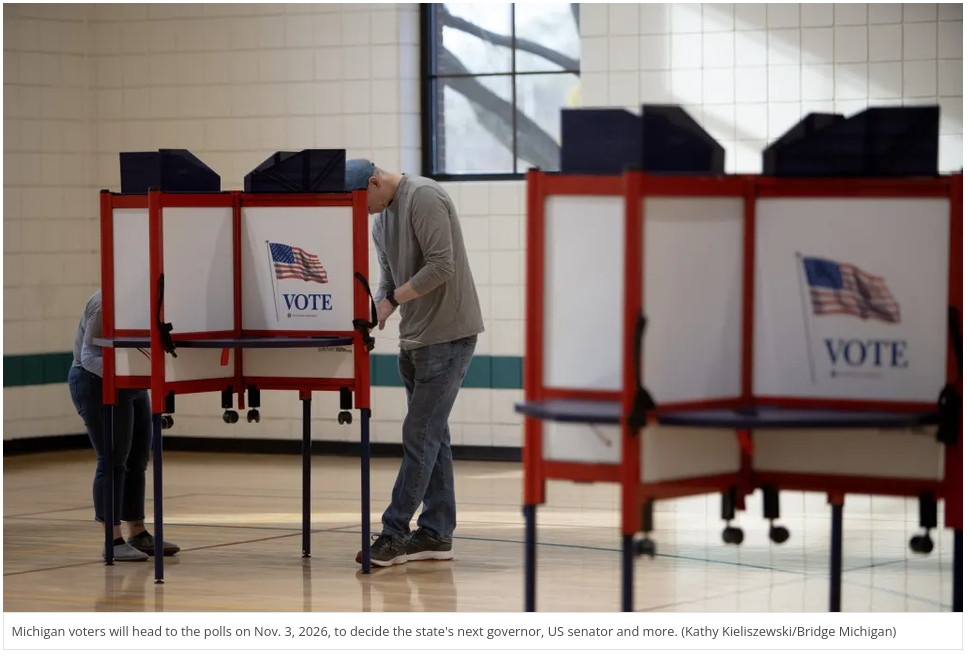
On Nov. 3, Michigan voters will choose their next US senator and governor, along with congressional and legislative races and hundreds of local tax proposals that could shape communities across the state.
The general election will help determine majority control of Congress and who succeeds outgoing Michigan Gov. Gretchen Whitmer, as well as which party holds the greater share of power in the state Capitol.
Related:
- These Michigan races could help decide control of Congress
- El-Sayed vs. Rogers: These voting groups may decide the Senate race
- Can James close the gap on Benson in Michigan governor’s race?
As of Oct. 27, nearly 1.4 million Michiganders had already cast absentee ballots or voted early in person, about 19% of all active registered voters, according to the state.
Check out the Bridge Michigan voter guide for more information on candidates, top issues and more. Here’s what else you need to know:
Key voting information
Election Day voting: Polls are open from 7 a.m. to 8 p.m. on Election Day. Voters in line by 8 p.m. can still cast a ballot. You can find your polling location on the Michigan Secretary of State’s website.
Early in-person voting: Early voting sites opened Saturday, Oct. 24 and will be open at least eight hours every day through Sunday, Nov. 1, though some communities offer expanded hours. Look up your early voting site and learn more about the process on the Secretary of State website.
Absentee voting: If you haven’t mailed back your absentee ballot yet, officials say it’s probably too late to do so. To ensure it counts, return it to a drop box or your local clerk’s office by 8 p.m. Tuesday.
Sample ballot: See what’s on your ballot before you vote by filling out this form.
Voter ID requirements: Bring a photo ID such as a driver’s license, state ID, US passport, military ID, student ID or tribal ID. If you don’t have one, you can still vote by signing an affidavit confirming your identity.
Same-day registration: Eligible residents can register and vote on Election Day at their local clerk’s office until 8 p.m. Bring proof of residency, such as a state ID, utility bill, paycheck or government document.
To register, you must:
- Be a US citizen
- Be at least 18 years old
- Have lived in your city or township for at least 30 days
- Not be currently serving a jail or prison sentence
Once your eligibility is verified, you can submit a registration application to the clerk.
Key races
US Senate: Voters will choose between Democrat Abdul El-Sayed, a former Wayne County public health official, and Republican Mike Rogers, a veteran and former member of the US House.
It’s one of the nation’s most closely watched races — and most expensive — a tossup that could determine which party controls congress for the last two years of President Donald Trump’s term.
The candidates are competing to replace retiring Democrat Gary Peters. If Rogers were to win, he’d be the first Michigan Republican elected to the US Senate in decades.
- Abdul El-Sayed under microscope: His record, from public health to podcasts
- Mike Rogers wants a job in the US Senate. What’d he do in the House?
Governor: As Whitmer closes out her second and final term, voters will decide whether Democratic Secretary of State Jocelyn Benson or Republican US Rep. John James will take her place.
Benson is enjoying favorable national headwinds from blowback towards the Trump administration and, beyond her own race, is stumping for state legislative candidates in key races in hopes of winning Democratic majorities in both the state House and Senate.
James recently told Bridge he’s working to build “word of mouth” at individual campaign stops and over the weekend appeared at a campaign rally with Trump and other Republican candidates. He’s been outspent but has gotten a late surge from a new pac testing legal donation limits.
- Jocelyn Benson as Secretary of State: What does her record show?
- John James’ in the US House: What does his record show?
Congress: There are several competitive races for the US House in Michigan that could play a role in whether Republicans keep their majority in Congress. Among them:
- Mid-Michigan’s 7th District, where incumbent Republican US Rep. Tom Barrett is facing a challenge from Democrat Will Lawrence, a progressive environmental activist and community organizer
- Macomb County’s 10th District, where Republican US Army Capt. Michael Bouchard and Democrat Christina Hines, a prosecutor, who are competing to fill the seat being vacated by James
- Southwest Michigan’s 4th Congressional District, where incumbent GOP US Rep. Bill Huizenga faces a challenge from Democratic state Sen. Sean McCann
Legislature: Control of the Michigan Legislature is on the line as both major political parties fight to win majorities.
Democrats currently hold a 20-18 seat advantage in the state Senate, while Republicans have a 58-52 edge in the House.
Though every House and Senate seat is on the ballot this year, experts say only a fraction are truly competitive and could decide the reception Michigan’s next governor will get in the Capitol next year.
Other :
- Attorney General: Doug Lloyd (R) v. Eli Savit (D)
- Secretary of State: Anthony Forlini (R) v. Garlin Gilchrist II (D)
- Michigan Supreme Court: Meet the candidates
- State Board of Education: Meet the candidates
Statewide proposals
Michigan voters will also weigh in on two statewide ballot measures this fall, including a decision on whether to rewrite the Michigan Constitution and a proposal to limit political spending by utilities and state contractors.
Proposal 1, which asks voters to convene a constitution convention, automatically appears on the ballot every 16 years and has been defeated in prior elections.
While a politically diverse coalition is aggressively campaigning against the proposal and there is no organized opposition, early polling suggested the measure could appeal to voters frustrated by the status quo in Lansing.
Proposal 2 asks voters whether to ban political spending in state elections by Michigan’s regulated utilities and large government contractors.
The group is heading toward Election Day with an endorsement from former President Barack Obama, who told Michiganders at a weekend rally to vote yes on the measure “so we can curb pay-to-play politics.”
Opponents argue it’s a means of stifling free speech. Should voters approve the measure, opponents are likely to sue to try to stop implementation.
Key local questions
Many Michigan voters will also weigh whether to raise their own property taxes to pay for essential local services, from police and fire departments to schools, libraries and parks.
There are more than 500 local proposals across the state to increase property taxes for things like public safety services, roads, libraries and parks and recreation, according to Gongwer News Service.
Local voters will consider 44 school bonds, several of which are second attempts by districts whose first pitches for more funding failed in May.
Dearborn Public Schools has the largest school bond on the ballot. The district is requesting a $1.5 billion bond “to build new schools, improve safety across the district, add hands-on STEAM learning spaces, renovate at every school, and eventually ensure that every school is air-conditioned.”
Top issues
Bridge has reported extensively on important issues ahead of the election through our Bridge Listens series, which used input from readers to guide our coverage.
Read more about the issues here, or read where governor candidates stand on:
- K-12 schools, literacy
- Health care costs, access
- Data centers, the environment
- Taxes, housing, affordability
- Democracy, elections, transparency
Bridge also hosted an inaugural Issues Summit in Detroit this month, bringing together civic leaders, policymakers and subject-matter experts to discuss some of the most pressing issues in the state.
This story was originally published by Bridge Michigan (bridgemi.com), a nonprofit and nonpartisan news organization. To get regular coverage from Bridge Michigan, sign up for a free Bridge Michigan newsletter here
This article first appeared on Bridge Michigan and is republished here under a Creative Commons Attribution-NoDerivatives 4.0 International License.

What to know about voting in Michigan’s Nov. 3 election added by admin on
View all posts by admin →