

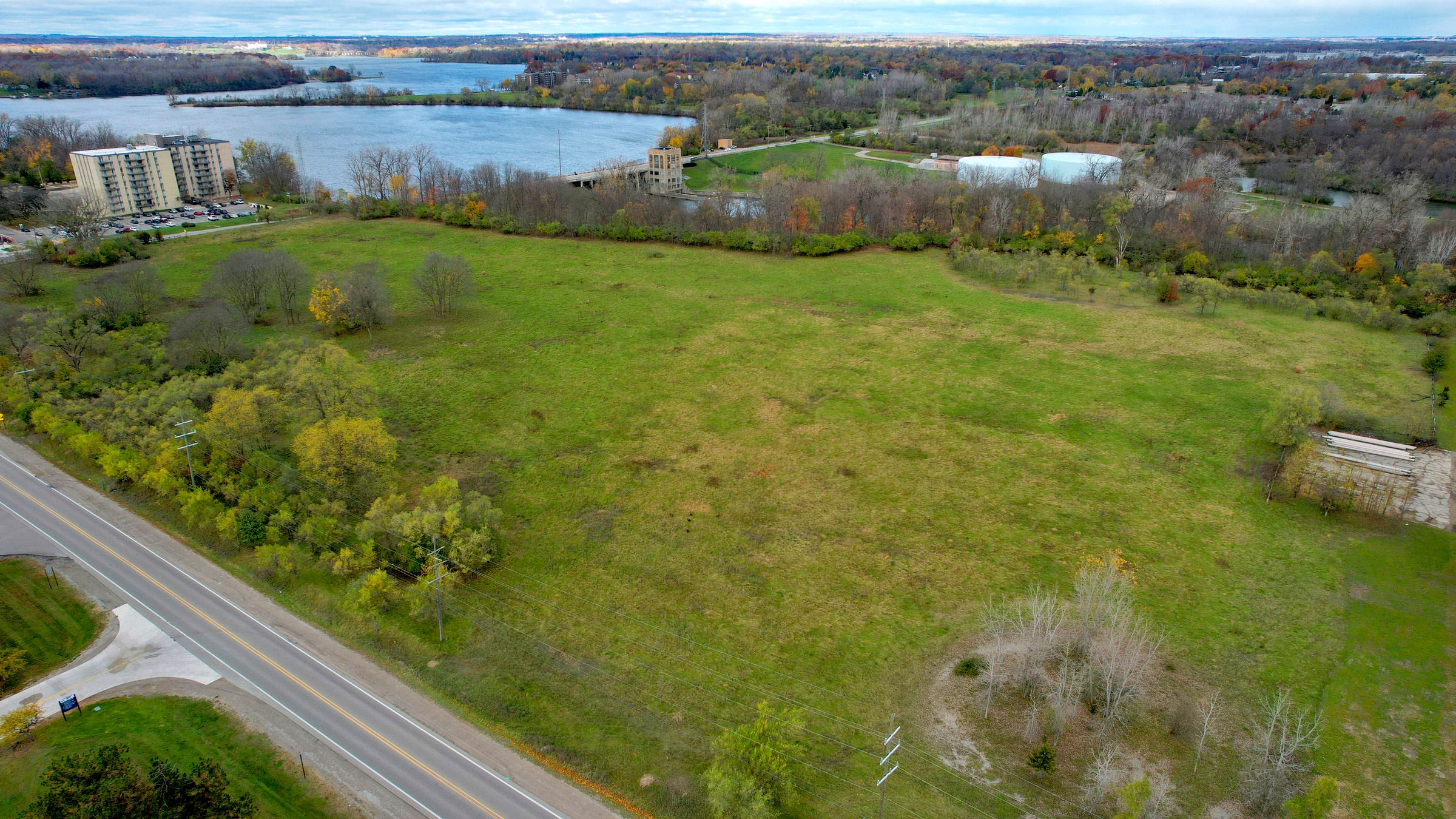
The controversial Ypsilanti Township site chosen by the University of Michigan and Los Alamos National Laboratory for a $1.25 billion data center project is “highly archeologically sensitive,” a major past trail route for Native American tribes that may include both artifacts and graves, the State Historic Preservation Office has informed project officials.
Both Ypsilanti Township and the United Tribes of Michigan, a coalition of the 12 federally recognized tribes in the state, have passed resolutions calling on U-M to undertake a comprehensive archaeological review of the 144-acre site on Textile Road near Bridge Road, and to better consult with the tribes before disturbing sites of potential significance to their heritage.
“It’s disgraceful that they have not reached out and consulted the Native American tribes, given the historic nature of their relationship at U-M with the Huron River and knowing full well that the Bentley Library is filled with information and maps on the indigenous Native American trails throughout Washtenaw County,” said Ypsilanti Township Attorney Doug Winters.
U-M proposes a “high-performance research computing center” at the site in partnership with Los Alamos National Laboratory, a New Mexico-based research institution focused on national security — including the manufacture of plutonium pits, the triggering mechanism in nuclear weapons.
The proposal has met with significant local opposition, with criticisms including the data center’s potential impacts on local water supply and quality, its energy consumption, its proposed placement in an undeveloped area along the Huron River rather than an industrial or brownfield site, and the university partnering with Los Alamos and its military industrial activity.
U-M construction project director Rob Green emailed the State Historic Preservation Office (SHPO) on Sept. 16. The office was established and authorized under the federal National Historic Preservation Act of 1966, which created state-level offices across the country to implement federal preservation policy. Overseen by a governor-appointed State Historic Preservation officer, the office evaluates, protects and promotes Michigan’s historic buildings, neighborhoods and archaeological sites.
Green, in his email to the preservation office, said his inquiry was prompted by community feedback.
“Through our community engagement, we have received some comments claiming there might be Native American burial grounds on the property,” he stated. “While we have not been able to find any direct evidence to support this claim, it was recommended by some of our colleagues in this field that we engage the SHPO as you have the most comprehensive records for researching this type of claim.”
Preservation office Cultural Resource Protection Manager Scott Slagor responded to Green via email the same day.
“It is true that the Huron River corridor is highly archaeologically sensitive, and a vacant parcel such as this may contain intact archaeological material,” Slagor stated. “Textile Road itself was a Native American trail.”

The risk of archaeological disturbances from construction included burial sites, Slagor said. “I can share that a site boundary with a recorded cemetery overlaps the property,” he stated.
“I strongly recommend engaging a federally qualified archaeologist to conduct an archaeological assessment … to best advise you on the path forward for the property.”
Slagor added that use of a human remains detection dog survey would be “most beneficial” in areas where an old cemetery is confirmed or suspected. He also recommended reaching out to tribal historic preservation offices.
“THPOs are the keepers of their cultural data and know of sites that we at SHPO do not,” Slagor stated.
Township, tribal concerns
Ypsilanti Township — a vocal opponent of the U-M-Los Alamos data center project and in particular its site choice — on Oct. 6 passed a resolution calling for the university, Los Alamos and anyone working on their behalf to “immediately cease and desist from site-disturbing activity” at the 144-acre project site “until comprehensive archaeological, cultural resource, cemetery-boundary, geophysical and human remains detection canine investigations have been completed.”
“The township passed a very strong resolution demanding no ground disturbance whatsoever until they complied with all of these recommended archaeological surveys,” Winters said. “U-M didn’t respond.”
Winters attended and spoke at the Oct. 16 United Tribes of Michigan quarterly meeting in Traverse City, where officials with the 12 federally recognized tribes in Michigan passed their own resolution in support of Ypsilanti Township’s.
“Ypsilanti Township is along the Huron River in Southeastern Michigan and is located in an area that was used by Indian tribes for river and trail travel throughout history,” a portion of the tribes’ resolution states. “The area includes many sites of burials and other locations indicating indigenous usage.
“United Tribes of Michigan expresses its support of Ypsilanti Township as it seeks to guide this potential development including its demand that consultation with the Tribes be conducted prior to any development.”
The University of Michigan “is committed to taking every precaution necessary throughout this process,” spokesman Paul Corliss said, adding the university has conducted title and background searches on the proposed project site, detailed site surveys and a basement environmental assessment.
“There was no evidence of archaeological artifacts or culturally sensitive materials found at the project site,” he said.
U-M will engage a federally registered archaeologist to consult with the State Historic Preservation Office on the project, he said.
“We are reaching out to the appropriate Tribal Nationals to ensure the project is proceeding with respect to the community,” Corliss said. “The university will follow all applicable legislation, regulations and processes as required throughout the lifetime of the project.”
The university has not yet broken ground on the data center project and no construction is yet taking place, he said.
“We are conducting the appropriate due diligence, design and study efforts to develop this project in a responsible manner,” Corliss said.
The U-M and Los Alamos “high-performance computational research facility” will not be a commercial data center and will use about one-tenth the energy required to fuel many commercial data center projects, facility project lead and U-M engineering professor Steven Ceccio said in a university publication in February.
“The high-performance computing facility we are developing will be a powerful tool for the U-M research ecosystem across a variety of fields, whether that’s accelerating drug discovery, conducting material science research or helping researchers rapidly identify new treatments for diseases such as cancer and infectious diseases,” he said. “We can model flood risks and extreme weather with street-level precision, giving local families and emergency responders more time to prepare.”
Plans for the facility
The university’s research space as part of the facility is slated at 50,000 square feet, with a proposed 240,000- to 300,000-square-foot federal portion of the facility slated to handle Los Alamos National Laboratory’s classified research and computational modeling for the U.S. Department of Energy and the National Nuclear Security Administration.
U-M officials this summer emphasized that the proposed data center “is not a military installation or weapons production facility,” and pushed back on earlier Ypsilanti Township characterizations of the proposed facility as a “Tier 1 High Value Target Risk.”
“No hazardous nuclear materials will be stored or used on-site, no weapons production will occur at the site and the facility will not conduct real-time defense operations,” U-M officials stated. “The laboratory’s work at the center will include computational modeling for nuclear stewardship — helping ensure the safety and reliability of the nation’s existing nuclear stockpile without live testing — as well as broader national security research in areas such as energy infrastructure and cybersecurity.”
The university student-run Michigan Daily, in a Jan. 30 article, quoted Patrick Fitch, deputy laboratory director for science, technology, and engineering at Los Alamos, who was present at the university’s open house on the project in Ypsilanti the previous day. When The Michigan Daily asked whether Los Alamos intended to use its portion of the data center to support nuclear weapons research, Fitch said yes.
“The short answer is yes, because aspects of a nuclear weapon [are] key to our simulation expertise,” Fitch said. “We want this loop to include large investments in national security, so that spins back into the basic science, and what we learn here — that list of non-nuclear weapons stuff — spins into nuclear weapons.”
Contact Keith Matheny: kmatheny@freepress.com.
This article originally appeared on Detroit Free Press: U-M-Los Alamos data center site ‘highly archeologically sensitive’
Reporting by Keith Matheny, Detroit Free Press / Detroit Free Press
USA TODAY Network via Reuters Connect

U-M-Los Alamos data center site ‘highly archeologically sensitive’ added by admin on
View all posts by admin →