

Michigan plans to scrap rarely used special ed rule. Child advocates fear harm
- Michigan is proposing changes to state special education rules
- Advocates are concerned one of the proposed changes will eliminate a protection for students with disabilities
- The state says it rarely uses the so-called ‘stay put’ provision
Michigan special education advocates say a proposed change in state rules could cause learning disruptions for children with disabilities.
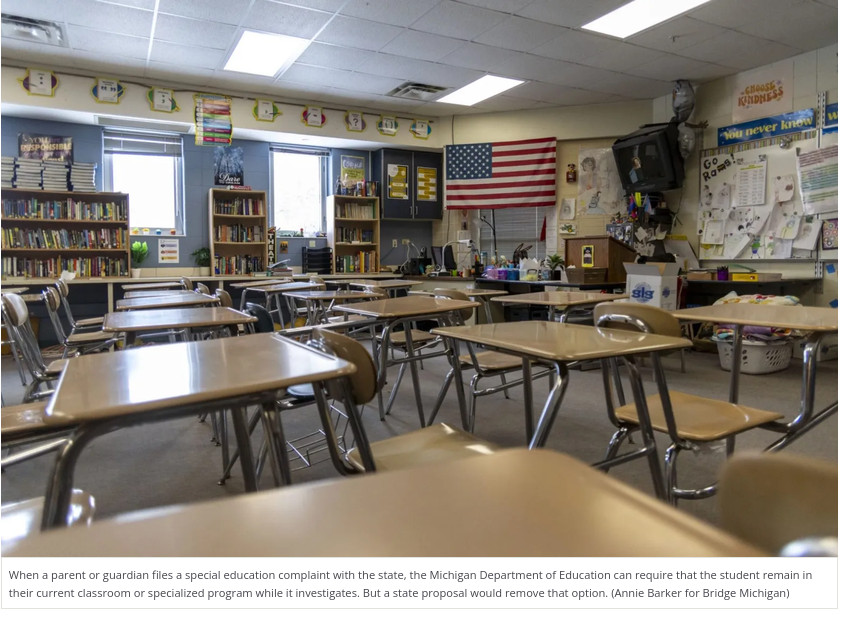
Currently, when a parent or guardian files a special education complaint with the state, the Michigan Department of Education can require that the student remain in their current classroom or specialized program while it investigates.
The department wants to strike this so-called “stay put” provision, arguing that it applies to legal proceedings rather than departmental investigations and that it has only been invoked once in the 47-year history of the state complaint process. It says the change aligns with federal disability law.
Advocates like Heather Eckner, director of statewide education at the Autism Alliance of Michigan, say the state should retain that option because removing a child from their educational setting while the state investigates could cause the student to lose instructional time and lead to “behavioral or emotional regression.”
“You should be looking at how to enforce this, not remove it,” Eckner told Bridge.
At issue is what kind of complaint the parent files. There are two types that are filed on the state level.
Related:
- Special education complaints jump in Michigan, as odds stacked against parents
- A renewed push to ban seclusion, reduce restraint in Michigan schools
- Michigan fight over special ed services lingers, years after COVID shutdown
- Short staff, Michigan schools use virtual special ed therapy. ‘This is not ideal’
- Special education in Michigan: Three things to know
One is called a state complaint. It’s free and triggers an investigation by Michigan’s Office of Special Education. The other is a “due process” complaint, which can be filed by the parent, the school district or the state and could be referred to an administrative law judge for a formal hearing.
Under the federal Individuals with Disabilities Education Act, when a due-process complaint is filed, the child must remain in their current education setting “unless the State or local agency and the parents of the child agree otherwise.”
A state complaint, on the other hand, does not automatically trigger a “stay put” order — although the state has that option. In September, the state Department of Education released proposed revisions to the Michigan Administrative Rules for Special Education, including removing “language allowing for stay put of a student placement in a state complaint.”
Education department spokesperson Bob Wheaton says the objective is to “properly align language with MDE’s actual authority.” He said the “stay put” provision applies when an individual initiates a due-process complaint, not when they file a state complaint. “The state complaint process is investigative in nature and not a qualifying legal filing,” Wheaton said.
Other proposed rule changes include offering a new special education endorsement for teachers.
The state has received more than 200 public comments on the proposals in six weeks. “The department will carefully consider comments from families, educators, advocacy groups and others before making a final decision on the proposed rule changes,” Wheaton said.
‘Potentially serious harm’
The idea of removing the stay-put option has angered groups like the Michigan Parent, Advocate and Attorney Coalition, which voiced its opposition in a letter sent to the state.

Going through the due process system is expensive. Jacquelyn Kmetz, a special education lawyer at Abdnour Weiker, estimates due process proceedings cost between $30,000 to $40,000.
It’s very hard for a parent to get a lawyer to take on the legal effort for free with so few special education lawyers in the state, said Kmetz, whose law firm specializes in serving students and educators.
Another option, filing a federal complaint, can involve waiting years for a resolution.
“Families should not have to initiate litigation-like proceedings simply to prevent potentially serious harm while MDE reviews a complaint,” the coalition writes. “That burden will fall hardest on families without attorneys, financial resources, flexible work schedules, or experience navigating special education law.”
Margo Pierce, a parent advocate and mother four adults on the autism spectrum, disagrees with the proposed change.
“If you take away the stay put, I don’t know what families would do besides filing due process,” Pierce said. “Because if you take that out, if you allow them to change a placement, that will automatically go into effect, whether the parent agrees or not in the 15-day time period. And once they’re out, it’s like trying to put toothpaste back in the tube.”
She said due process options are expensive for families and more challenging because of a “huge” shortage of special education lawyers in the state. Pierce said “a lot of parents” are reluctant to file any type of complaint because of fear of retaliation.
Toby Ward, a former special education teacher and father of a 20-year-old son who attended special education in Kalamazoo, also disagrees with the proposed change.
“I think it’s ludicrous, I think it removes a major protection of students,” said Ward. “But also…I think it also becomes an issue of parents’ rights.
“A parent has the right to advocate for their child and do what they think is best. And when a district doesn’t do that, in their opinion, they have recourse for that. And the stay put provision really prevents the school from making a decision unilaterally without ignoring, I think, one of the most important members of the IEP team, which is the parent.”

The alliance letter questions the timing of the proposal to remove the stay put option.
State Superintendent Glenn Maleyko started last December, a new deputy superintendent who oversees the special education department started in April and the state has formed a bipartisan special education committee but has yet to do wide community engagement sessions across the state. (The first listening session is planned for Saginaw Nov. 9.)
“This sequence raises a basic question: Why eliminate a longstanding student protection now, before the state’s newly established special education committee has completed, or even begun, its planned statewide engagement?,” the coalition letter says.
Michigan schools continue to face high special education teacher shortages, advocates push for special education funding reform and the federal government has moved oversight of special education away from the US Department of Education.
State complaints have risen at a higher rate than the increase of students attending special education, Bridge previously reported.
There were 226,800 Michigan students receiving special education last school year in public, private or homeschool settings.
This includes people from birth to 26 who have an Individualized Education Plan or Individualized Family Service Plan. These are personalized learning plans for students in special education that outline student goals and supports needed to accomplish the goals.
This story was originally published by Bridge Michigan (bridgemi.com), a nonprofit and nonpartisan news organization. To get regular coverage from Bridge Michigan, sign up for a free Bridge Michigan newsletter here
This article first appeared on Bridge Michigan and is republished here under a Creative Commons Attribution-NoDerivatives 4.0 International License. 

Michigan plans to scrap rarely used special ed rule. Child advocates fear harm added by admin on
View all posts by admin →