

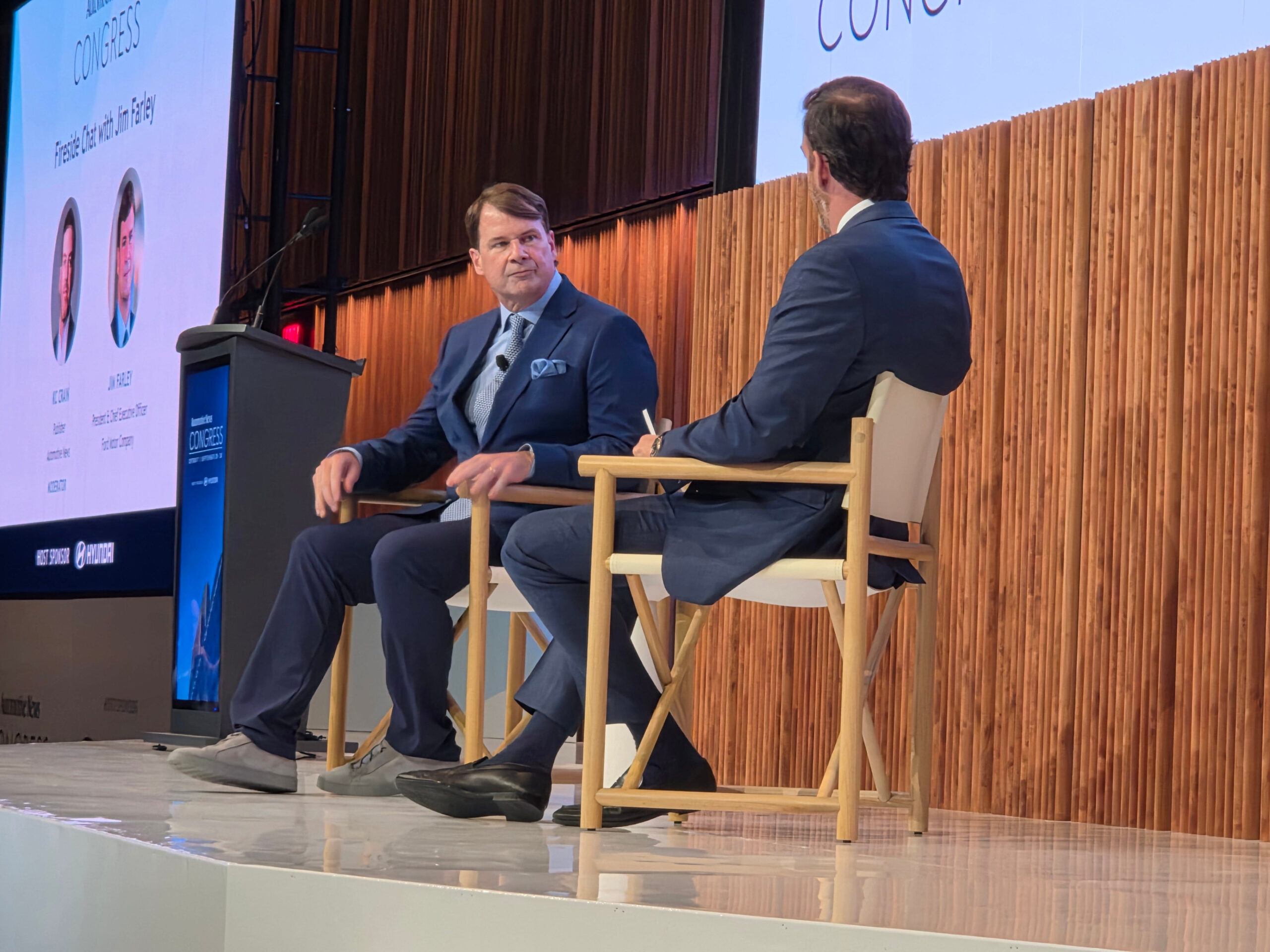
Ford Motor Co. CEO Jim Farley defended the automaker’s decision to partner with Chinese companies in an apparent retort to recent criticism from Secretary of Transportation Sean Duffy.
At the same time, Farley issued caution in allowing Chinese carmakers to enter the United States to sell their vehicles, noting the government subsidies the Chinese automakers receive allow them to sell cars for a much cheaper price than other automakers could do.
Farley said Chinese-made vehicles now comprise 25% of all new-car sales in Mexico and if they were to get such a foothold in the United States, it could endanger the industrial base and jobs.
“I watched what’s happening in Europe right now,” Farley said, referring to Chinese automakers now selling cars there and capturing marketshare.
“It’s really something that they have to deal with now, and it’s too late. In our country, we just have to be very careful considering it. These vehicles can drive themselves. They can take videos of everything. It’s amazing what a car can do. For national security alone, it’s critical that we think about: How do we find the right bounds?”
Farley made the comments during a wide-ranging interview Sept. 29 at Automotive News Congress in Detroit.
‘Stop the drama’
As Farley addressed his feelings on allowing Chinese carmakers into the United States, he also addressed Ford’s position on partnering with the Chinese companies, and an unprovoked response, to recent controversy.
On Sept. 8, Duffy sent a letter to Farley, which Duffy’s team shared with the media, that criticized what Duffy said is the Dearborn-based automaker’s increasing reliance on foreign adversaries, including China, for critical manufacturing components.
Duffy’s letter said he was writing to express “the profound concern of the U.S. Department of Transportation (DOT)· regarding the strategic trajectory of Ford Motor Company (Ford or Company), specifically as it pertains to American national automotive manufacturing integrity, supply chain exposure, and reliance on technologies of foreign adversaries.”
Ford is partnered with CATL in its development of electric vehicle batteries and battery energy storage systems. In July, Ford announced it and Geely Automobile Holdings, based in Hangzhou, China, agreed to form a Europe-focused joint venture at Ford’s factory in Valencia, Spain, where Ford makes the Ford Kuga, a small SUV sold in European and global markets.
Farley said partnering with these companies is not a new business strategy for Ford — or for any business, for that matter.
“We’re going to partner with the Chinese and we’re going to compete with them. Both can be totally fine, they are not mutually exclusive,” Farley said. “So, stop the drama. Just get on with designing good vehicles, great software, great experiences, a great relationship with your owners and suppliers — and we can compete.”
Ford’s partnership in licensing technology from CATL has helped Ford enter a new business called Ford Energy, a subsidiary that will make battery storage systems. Ford will make EV batteries using CATL’s technology at its Blue Oval Park Michigan in Marshall.
“That’s our factory,” Farley emphasized, but noted that CATL is a leader in battery production, so the partnership is “a good solution. It’s American jobs. We’re learning. We’re working with them. We’re solving problems together. It’s better than importing batteries.”
Jamie L. LaReau is the senior autos writer at USA TODAY Co. who covers Ford Motor Co. for the Detroit Free Press. Contact Jamie at jlareau@freepress.com. Follow her on Twitter @jlareauan. To sign up for our autos newsletter. Become a subscriber.
This article originally appeared on Detroit Free Press: Ford CEO Jim Farley defends automaker’s ties to Chinese companies
Reporting by Jamie L. LaReau, Detroit Free Press / Detroit Free Press
USA TODAY Network via Reuters Connect

Ford CEO Jim Farley defends automaker’s ties to Chinese companies added by admin on
View all posts by admin →