

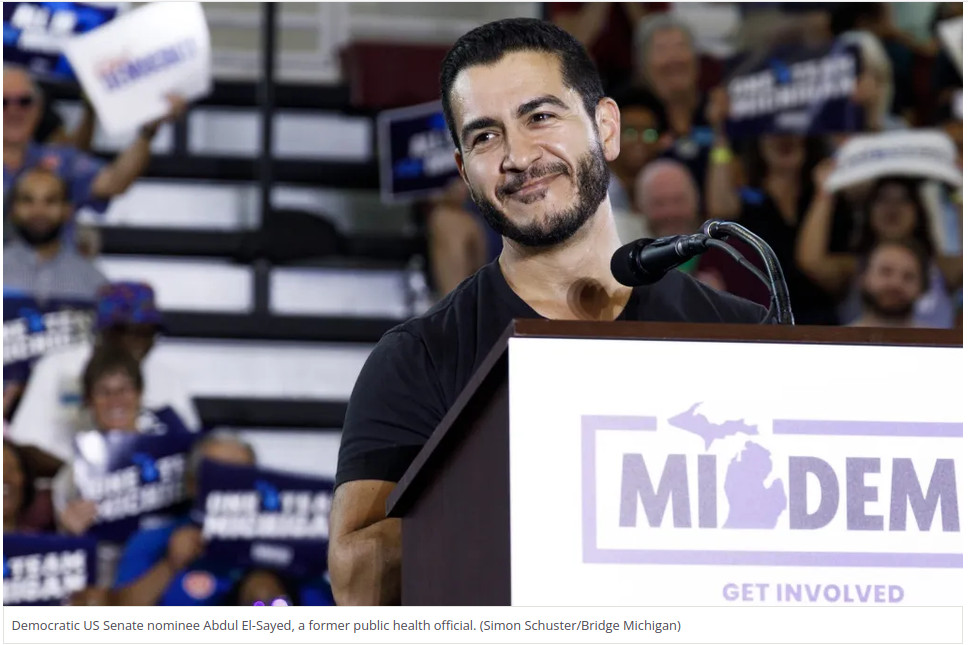
Fact check: What Abdul El-Sayed said about breast cancer research, advocates
This story was originally published by Bridge Michigan (bridgemi.com), a nonprofit and nonpartisan news organization. To get regular coverage from Bridge Michigan, sign up for a free Bridge Michigan newsletter here
- In 2012, Abdul El-Sayed wrote an essay critiquing research funding allocations based on lobbying
- El-Sayed cited breast cancer research, calling it important but noting it is not as fatal as other cancers
- Republican rival Mike Rogers is using the essay against El-Sayed as they compete for a US Senate seat
In a new advertisement, Republican US Senate candidate Mike Rogers claims Democratic rival Abdul El-Sayed “blasted” breast cancer patient advocates and called increased research funding for the disease “disturbing.”
The ad cites media coverage of an op-ed that El-Sayed wrote in 2012 as a postdoctoral public health researcher at Columbia University.
Related fact checks:
- Mike Rogers, John James shift positions on Iran war
- What Abdul El-Sayed said about freeing prisoners
- Can Mike Rogers ‘put a shop class in every high school’?
El-Sayed’s essay critiqued how lobbying has led to what he considered disproportionate research funding. He wrote that “powerful” groups like Susan G. Komen Foundation increased funding and awareness even though “numbers suggest there are other diseases (women) should be far more worried about.”
But the article didn’t blast advocates or lobby for decreased funding for breast cancer, which El-Sayed wrote is “an incredibly important disease” worthy of attention.
So what gives?
The claims are among many that Bridge Michigan is fact-checking ahead of the Nov. 3 election, including claims about Rogers’ shifting position on the Iran war. The winner of the race between Rogers and El-Sayed will succeed retiring US Senator Gary Peters.
The claims
In the Rogers ad, the narrator says, “Abdul El-Sayed blasted breast cancer patient advocates, saying increased funding for breast cancer was disturbing because it benefited women with social power and privilege. What is wrong with Abdul El-Sayed?”
Rogers repeated similar claims in a recent Fox News interview, calling El-Sayed’s comments on breast cancer research “disqualifying.”
In the 2012 piece, El-Sayed discussed an academic journal article that found single-disease lobbying groups were successful in obtaining more research funding from the National Institutes of Health. The article, he wrote, was “clarifying—if not disturbing.”
Breast cancer impacts 1 in 8 women over their lifetimes, but is less fatal than some other diseases. El-Sayed’s essay noted that while advocacy groups have raised awareness about breast cancer, women are more likely to die of lung cancer and heart disease.
“It’s also possible that advocacy is a function of the social power and privilege of those most likely to get a disease — one of the findings of the article. If so, that would mean that disease-specific lobbying would drive funding toward more survivable, less deadly diseases more likely to affect those with access to treatment.”
Asked about the 2012 essay and recent claims about it, El-Sayed campaign spokesperson Cole Wozniak said that “Abdul spent his career fighting to improve health outcomes for Michiganders, including working to provide preventative screenings, mammograms and more.”
Wozniak criticized Rogers for congressional votes to repeal or weaken the Affordable Care Act, the 2010 health care law that protects coverage for people with preexisting conditions, “including breast cancer.”
Asked about the ad, Rogers campaign spokesperson Alyssa Brouillet repeated its claims, telling Bridge: “You want to talk about disturbing, let’s start with how Abdul is diminishing all these women who are fighting for their lives to beat breast cancer. How about how he accuses them of having ‘power and privilege.’”
What the research says
Experts say distributing funding for disease research isn’t a perfect science.
Rachel Best, a sociology professor at the University of Michigan, authored the paper that El-Sayed based his 2012 op-ed on. “The way we are currently allocating research dollars can have unintended consequences or lead to distributing money in a way that doesn’t always match the burden of disease,” said Best, who wrote a book on the subject in 2019.
“It’s not a zero-sum game between diseases, but it’s definitely still true that we have these big rushes of public attention and money to a small number of diseases while others are neglected,” Best told Bridge.
In a 2026 paper, researchers from the National Cancer Institute found that federal research funding is not distributed proportionately to the cancers with the highest lethality rates. The researchers noted several cancer types have higher mortality rates but are the subject of less research funding.
In 2025, the National Cancer Institute distributed $1.58 billion in funding for breast cancer research, $494 million for colon cancer research, and $62 million for small cell lung cancer research. Small cell lung cancer, for example, has a five-year survival rate of 9.1% and breast cancer has a five-year survival rate of 91.7%.
Breast cancer is among the most common cancers, an estimated 322,000 US women will be diagnosed in 2026. While fewer women are diagnosed with lung cancer, about 118,500 new cases in 2026, the disease is more fatal than breast cancer.
Bottom line
El-Sayed never blasted breast cancer advocates, as the Rogers’ campaign claims.
His 14-year-old op-ed was a call for equity in research that cited breast cancer research as an example. He wrote that it’s “disturbing” that funding decisions are sometimes based on interest group lobbying, rather than data.
This article first appeared on Bridge Michigan and is republished here under a Creative Commons Attribution-NoDerivatives 4.0 International License.

Fact check: What Abdul El-Sayed said about breast cancer research, advocates added by admin on
View all posts by admin →