

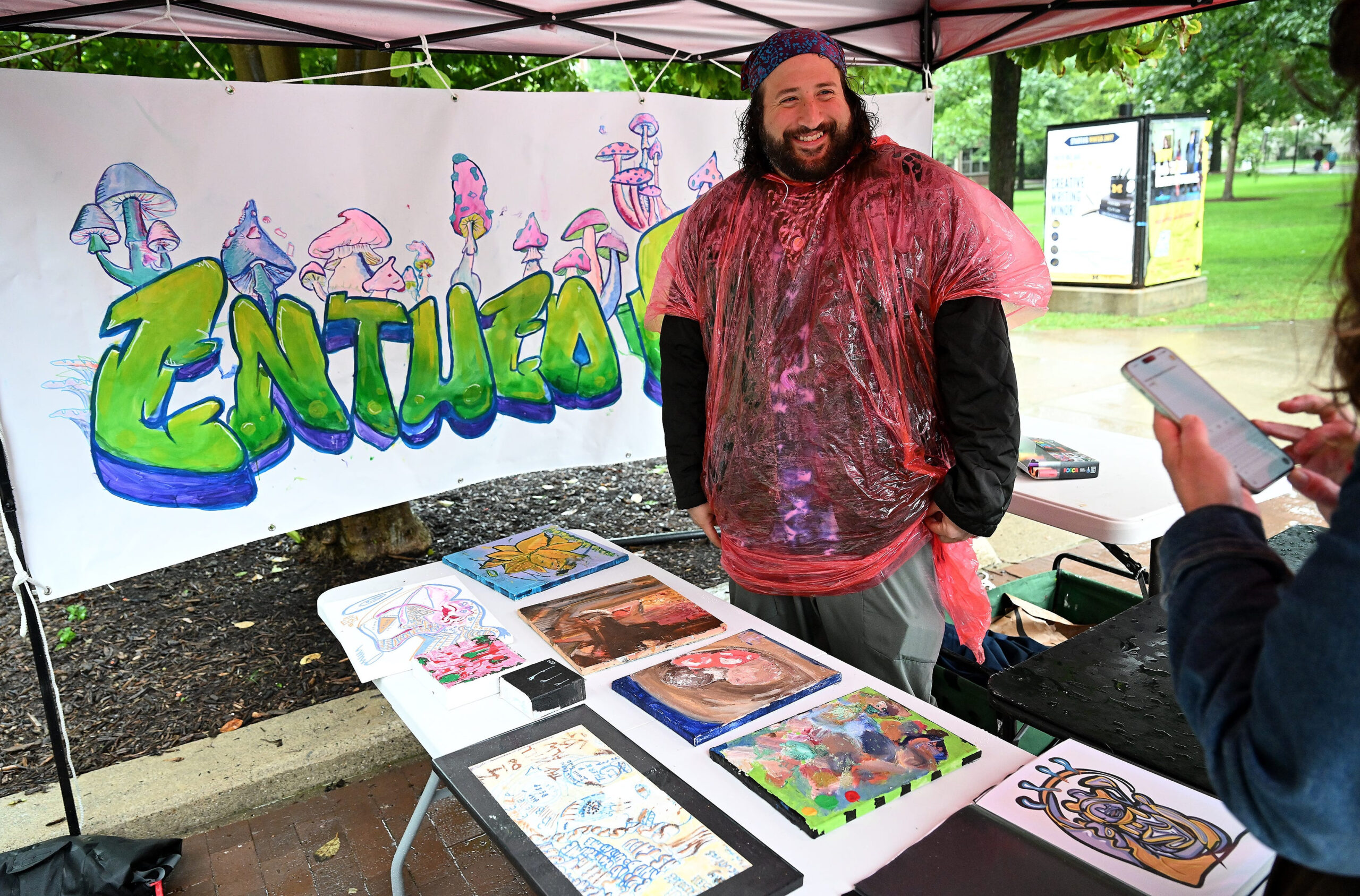
ANN ARBOR — Organizers of Entheofest have a dream, or maybe it’s a hallucination, that one day the state of Michigan will rise up and fight for the freedom to eat magic mushrooms.
The annual festival, held Sunday, Sept. 20 at the University of Michigan Diag, celebrated drugs but not just any narcotic.
The crowd’s pharmaceutical of choice is made by Mother Earth, not man. They like natural psychedelic drugs like mescaline, ibogaine and ayahuasca. Sorry, Molly.
“It’s all eco over ego,” Cecelia Infante, a beekeeper from Whitmore Lake, said to cheers from the audience.
The attendees’ views on drugs fit into an ethos that is pro-environment, anti-Big Pharma and pro-indigenous cultures. The hippie vibe was deep.
Tens of thousands of words were uttered during speeches and panel discussions Sunday, but one rarely heard the word “drugs.”
On the other hand, “medicine” was mentioned so often it sounded like a medical convention. Even better was “sacred medicine,” referring to the use of the drugs in ancient cultures.
The name of the festival comes from “entheogen,” a term invented by plant researchers to avoid the negative connotations of psychedelics.
“It’s been used as medicine for 10,000 years,” said Lucy Davenport of Ann Arbor, who attended with two friends. “The AMA (American Medical Association) wants to think it discovered medicine.”
Organizers began holding the event after the Ann Arbor City Council voted in 2020 to decriminalize the use of natural psychedelic drugs. Detroit voters followed suit the next year.
They hold it near the anniversary of the Ann Arbor council vote. Sept. 20 was also Global Mushroom Day, but that was just a happy coincidence.
Now the hippies are looking for more. They want the entire state to remove criminal penalties against the drug.
But Ann Arbor is hardly a bellwether in Michigan. California, maybe, but not this purple state.
“This new cultural change is only growing stronger,” said Chris Kurtz, a longtime drug decriminalization activist from Ann Arbor. “There’s so much to do and absolutely no time to waste.”
Backing up his words, Kurtz talked quickly as he tried to make all his points within the five minutes allotted to each speaker.
Advocacy without lawbreaking
Despite the city council’s vote, organizers asked visitors not to imbibe and entrepreneurs not to sell to imbibers.
Past festivals had people openly selling drugs, including a wagon-pulling man announcing he had “live peyote,” according to a published report.
The crowd of 60 attendees on Sunday seemed to be behaving itself — during the event. When one speaker asked how many people had eaten magic mushrooms that day, about half the crowd cheered.
The dress code was drug casual, with outfits ranging from a tie-dyed poncho to a fleece pullover embroidered with cannabis plants to a T-shirt reading “Hug Dealer.”
One man standing in the rain gyrated his body and flailed his arms as a speaker described the life of a honeybee.
Festivalgoer Helena Seymour of Saline said she has been eating psychedelic mushrooms for five years and, in fact, had some that morning. She said she doesn’t even recognize the pre-mushroom version of herself.
“They’re great. Like anything, you can’t overdo it,” she said.
Watching all this were two campus police officers who were chatting next to a Welcome to the Diag sign. Three other officers showed up but left before the event was over.
Their enforcement powers, however, were questionable. If there was any doubt, Washtenaw County Prosecutor Eli Savit has attended several past festivals, describing how he extended the council’s decriminalization edict to the entire county.
Savit, who is running for Michigan Attorney General and has been criticized for his stance on the drug issue, didn’t attend Sunday.
Also not attending were several state legislators who have supported the movement in the past. It may have been the weather, which rained all day, or it may have been the midterm elections just six weeks away.
Decriminalizing psychedelics will take time, marijuana activist says
Jamie Lowell of Ferndale cautioned the crowd that change won’t come quickly. His is the voice of experience. He is a co-organizer of Hash Bash, the annual cannabis rally that has been in Ann Arbor for 54 years.
In November 2018, after decades of prohibition, Michigan voters legalized the consumption of marijuana for recreational purposes, a decade after decriminalizing medicinal use.
“It’s a marathon, not a sprint,” Lowell said. “Much more needs to be done.”
As speakers stood on the steps of the Hatcher Graduate Library, with its mammoth ivy-covered façade looming over them, assorted groups distributed drug literature from tables around the perimeter of the Diag. One table gave tarot readings.
Among the groups was a student organization called The Lookout Project. That’s “Lookout” as in taking care of people, not “look out, the police are coming.”
The student group, which fights to prevent overdoses, distributed naloxone kits during the event.
“We believe in peace and compassion,” said Rasha Hamoudi, the group’s co-president.
The advocates also discussed the benefits of other sources of natural psychedelic drugs, including fungus and animals.
One speaker, Antwoine Perry of Detroit, made the questionable claim that snake venom can be used to cure herpes.
Perry, who also goes by the name Sincere Seven, described himself as a shaman and the first U.S. practitioner of using snake venom for medical treatment.
Wearing pants with multicolored patches, Perry said he was first taken aback when someone mentioned the use of psychedelic mushrooms to help people.
“Mushrooms? I ain’t Eminem,” he said he told the other person.
‘Shrooms in school?
Another Detroit entrepreneur sang the praises of magic mushrooms.
Denis Vidmar, owner of the Mushroom Hub, wants to bring mushrooms to school cafeterias across the nation.
“Fungi is the solution to every problem we have,” he told the crowd. “When we fix man, we will fix every problem we have.”
Vidmar, who wore a T-shirt reading “Fungi is Life,” said mushrooms should be added to every meal because the more you eat them, the better you feel.
“Love and kindness is what mushrooms are,” he said. “Mushrooms and fungi, this is the solution.”
The keynote speaker was Abbie Rosner, who wrote a book, “Psychedelics and the Counterculture of Aging.”
Rosner, who signed copies at an Ann Arbor bookstore the evening before, said she interviewed 36 older adults who took psychedelic drugs and most of them described it as the happiest moment of their lives.
One person said it was the first time they experienced unconditional love during 70 years of living.
The narcotics could change the way society treats the elderly and the way we approach dying, Rosner said.
“Getting old doesn’t have to be a horrible and terrible thing,” she said.
The event was emceed by a local comedian, Zach Martina. He kept the loose crowd even looser with various quips between speakers.
“I’m just up here scatting,” he said at one point.
At the end, he told the crowd his next comedy show was Sept. 25 at River’s Edge Brewing Co. in Milford.
fdonnelly@detroitnews.com
(313) 223-4186
@prima_donnelly
This article originally appeared on The Detroit News: Dream or hallucination? Advocates want Michigan to legalize psychedelic drugs
Reporting by Francis X. Donnelly, The Detroit News / The Detroit News
USA TODAY Network via Reuters Connect

Dream or hallucination? Advocates want Michigan to legalize psychedelic drugs added by admin on
View all posts by admin →