

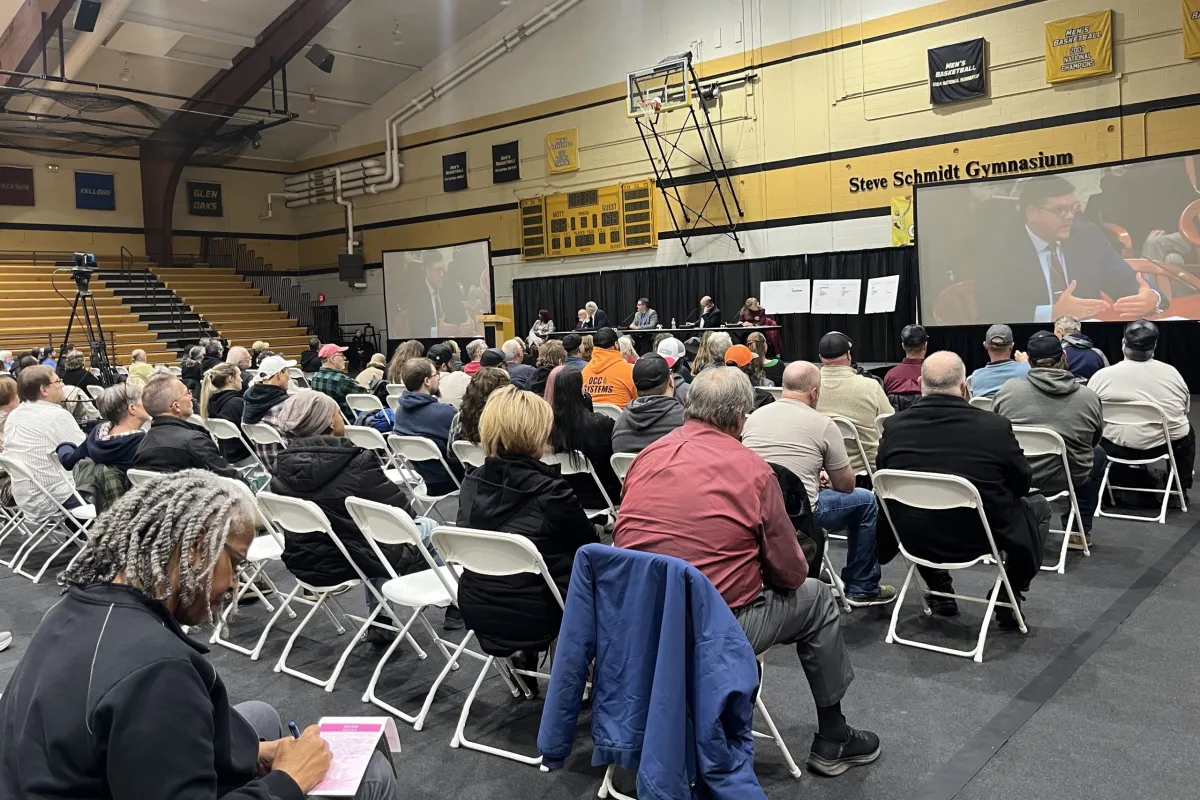
- Genesee County’s megasite development is still plagued by issues of community trust, residents said at a town hall meeting on Thursday
- Other residents agree with officials who say that creating jobs is important for the county
- Yet questions persist over the role of state incentives funding the purchase of 1,300 acres for private industry
FLINT — Hopes for jobs and worries about trust drove most of the discussion Thursday during a town hall forum on the megasite property funded by the state in Genesee County.
At least 200 people gathered at the Ballenger Field House at Mott Community College for the discussion, ranging from local residents and officials to a group of students wearing matching union garb.
The topic of the megasite is “important not just to Genesee County … but to Michigan as a whole and to the nation as well,” organizer Bill Ballenger said. “It is the question of whether state government should use taxpayer dollars … to lure private businesses to Michigan.”
The question remains top of mind in southern Genesee County. Demolition continues on the 1,300-acre site in Mundy Township, about four months after semiconductor maker Sandisk canceled plans to build a $63 billion semiconductor complex on the property purchased with $261 million in state funding.
The company had promised to create 7,400 jobs over 20 years.
Related:
- Michigan has spent $261M on Mundy megasite. Now, the public weighs in
- Swartz Creek shoots down $40M offer to sell school for Michigan megasite
- Michigan officials defend $20B Sandisk incentive offer scrutinized by legislators
Panelist and former Democratic US Rep. Dan Kildee recalled how General Motors once employed 75,000 in the city, with Flint having the second-highest wage scale in the nation. The change remains drastic as the automaker disinvested in the area over decades.
Jobs are “the biggest need in our community,” said Kildee, who is now CEO of the Community Foundation of Greater Flint.
Many in the audience agreed, but some rejected that should be the only consideration for the area and the state. Many expressed anger at what they called the secrecy of the project.
A few pointed out that the only reason that residents and state officials knew about the scope of the state incentives was because Gov. Gretchen Whitmer announced that Sandisk withdrew its plans to build in Mundy Township.
By then, the state had been prepared to offer $6 billion in cash benefits and upward of $20 billion in incentives — among them, a 50-year tax break.

“We’re not against jobs,” said panelist JoAn Mende, an anti-megasite activist. Water concerns and loss of farmland are issues, she added. So is long-term viability of a business that could be established on the site.
“What we are against is the fact that no one has asked the residents,” Mende said.
“Shame on this whole concept for pitting the people against one another and reducing the people to a single dollar value.”
James Hohman, director of fiscal policy at the Mackinac Center for Public Policy free-market think tank, said from the stage that discussions of the megasite need to recognize the skepticism around economic development incentives.
The megasite was funded largely through the recently defunded Strategic Outreach and Attraction Reserve (SOAR) fund, which allowed over $1 billion to nine deals. Many are in development, but other deals have downsized.
So far, the incentives have created no jobs.
The latest state job counts from incentives will be tallied in early 2026.
Michigan shouldn’t assume that government incentives are an “effective use of taxpayer dollars or effective use of creating jobs,” Hohman said.
“Most businesses pay for their own land,” Hohman said. “Most businesses pay taxes. They don’t receive taxes from other taxpayers. This is the normal order of things, and … it works.”
Hohman also noted that Michigan has authorized $15 billion for Michigan’s auto industry “and we have half of the auto jobs as we did in 2000.”
State Sen. John Cherry, D-Flint, a panelist who represents most of Genesee County, including Mundy Township, called incentives “a necessary evil” to gain investments.
Kildee cast the megasite as making the area competitive for a host of incentives, including ones supported by the Trump administration and not just the state.
“We do not have the tax base required to provide essential public services necessary in order to compete,” Kildee said of Genesee County.
If the county wants to rebuild its jobs base, “the jobs do have to land someplace,” Kildee said. “We have to have an honest debate about where they should be.”
But while the Michigan Economic Development Corp. and the Flint and Genesee Economic Alliance say they continue to market the megasite, residents make the point that the “where” Kildee mentions has been determined without them.
And they are not likely to know what’s coming next until the last possible moment.
“What has been targeted for Mundy Township?” Mende asked. “No one knows.”
Business Watch
Covering the intersection of business and policy, and informing Michigan employers and workers on the long road back from coronavirus.
About Business Watch
Subscribe
Share tips and questions with Bridge Business Editor Paula Gardner
Thanks to our Business Watch sponsors.
Support Bridge’s nonprofit civic journalism. Donate today.
This must be the credit given on each article: Put at bottom of each article in small print
“This story was originally published by Bridge Michigan (bridgemi.com), a nonprofit and nonpartisan news organization. To get regular coverage from Bridge Michigan, sign up for a free Bridge Michigan newsletter here (https://bit.ly/BridgeMichiganNewsletter).”
Use photos as well and credit photos. Simply copy and paste name and put: Photo Credit: John Doe

Hope, anger on display at town hall as $261M megasite forges ahead near Flint added by Tribune on
View all posts by Tribune →