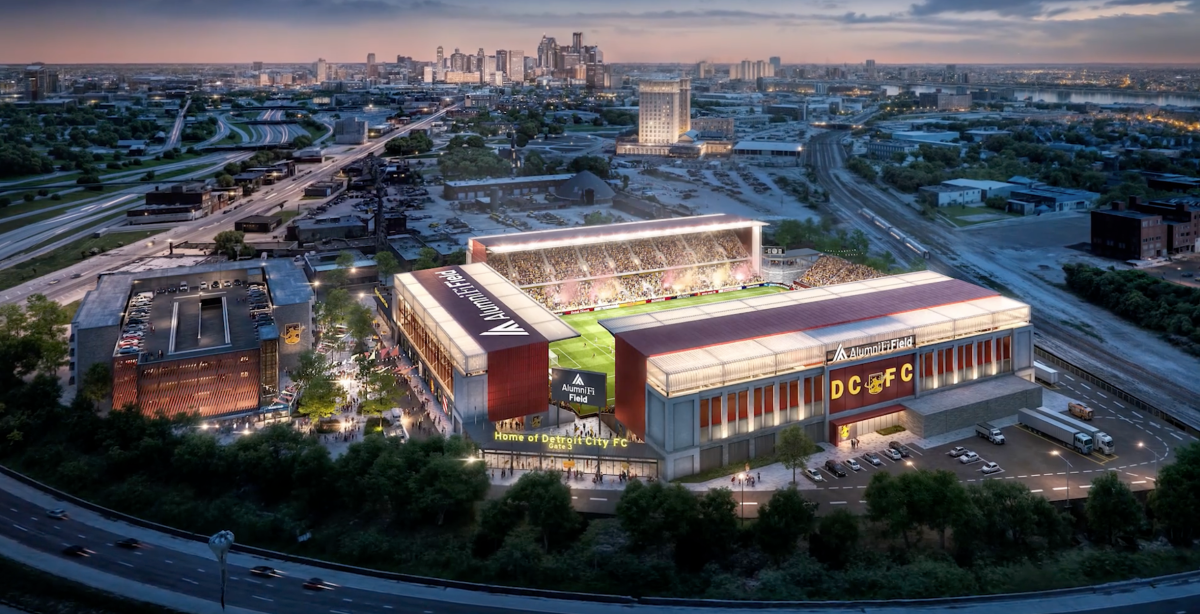
The $198 million project includes a 15,000-seat stadium, 421-space parking deck and 76 apartment units. It will be located on the site of the former Southwest Hospital at 20th Street and Michigan Avenue after the aging building is demolished.
DCFC’s benefits agreement includes a commitment to invest $1.2 million over the next 12 years in community organizations. Other commitments include a $17 minimum wage and union neutrality for arena workers, 3,000 annual free tickets for residents, a new youth soccer mini pitch and a $50,000 investment in art installations, among other things.
Related:
The City Council unanimously approved a site plan and $4.4 million tax break for the $50 million WNBA headquarters along Detroit’s east riverfront.
The former Uniroyal site would house a practice facility and headquarters by 2029 for Detroit’s incoming WNBA team. A youth development academy is planned for a second phase of the project, with multiple outdoor athletic fields that can host regional tournaments.
Detroiters expressed support for the DCFC project and WNBA facility because both create opportunities for youth sports. Unlike the DCFC stadium, the WNBA project won’t undergo an intensive community benefits process.
Tier 1 projects valued at $75 million must negotiate a community benefits agreement in public meetings with residents. Benefits packages have created millions of dollars in additional investments for a variety of community interests.
Tier 2 projects valued at $3 million or more require developers to partner with the city’s workforce agencies to ensure residents get job opportunities. There’s no requirement for a benefits agreement.
The WNBA facility qualifies as a Tier 2 project because the investment is valued at $50 million. The cost of the youth sports component hasn’t been released yet. Pistons executives said the youth complex is considered a separate project with details yet to be determined. Activists with the Detroit People’s Platform argued the city should require a benefits deal anyway.
A plan for the former Uniroyal site on the riverfront includes one project with two components: A $50 million, 75,000-square-foot WNBA headquarters and a 100,000-square-foot youth development academy owned and operated by an yet-to-be named nonprofit. Credit: Source: Rossetti
No community benefits process
Community Development Advocates of Detroit, a nonprofit organization that often organizes residents around issues handled by the council, argued the lack of community benefits in the WNBA project is a “disappointing missed opportunity for Detroit.” CDAD called for reforming the ordinance.
In a statement, the organization said the process bypassed it by splitting the project into smaller components that fall below the community benefits threshold.
Richard Haddad, chief operating officer for Pistons Sports and Entertainment, previously disagreed with this framing, saying splitting the project wasn’t an intentional move to avoid a benefits process.
Council Member Gabriela Santiago-Romero is convinced the local ordinance isn’t working, but reform may not be the solution. She said benefits deals often fall short of what residents seek and she’d rather pursue an arena tax to create revenue for community investments.
“After going through many of these, I do not believe the (community benefits ordinance) is ever going to yield the results that Detroiters deserve based on how much we’re giving (in tax breaks),” Santiago-Romero said.
Residents had unsuccessfully advocated for creating a $1 fee on each DCFC ticket to fund home repairs in Corktown. Santiago-Romero said all stadiums should be taxed.
“These stadiums are very lucrative and until we have a system where we are taxing or having a fee charge for us to benefit from these stadiums, we’re going to continue to lose out,” Santiago-Romero said.
Creating an arena tax , which would also require a change in state law, could raise revenue for investments recommended by the city’s industry standards board.
The labor board, representing Detroit arena workers, asked the City Council to promote policies that enhance safety outside stadiums and improve access to child care and reliable transportation.
Chair Joe Miller and Secretary Jeremy Bodary said workers deserve to benefit from taxpayer-funded arenas. A study by Wayne State University found one third of arena employees live in poverty and 72% have no employer-provided health insurance.
Eighty-five percent of arena workers cited wages as their top concern.
Detroit resident Jasmine Kaltenbach said the report “really calls into question the extent to which Detroiters benefit financially from these developments.” Kaltenbach is director of the Home Rule Project, which works with unions to build coalitions around changing state labor laws.
She praised DCFC developers for committing to a minimum wage and union neutrality while also asking for fewer tax breaks than Little Caesars Arena and other stadiums. But Kaltenbach said labor standards DCFC agreed to should apply to all taxpayer-subsidized developments.
The industry standards board advocated for working with state lawmakers to repeal a preemption law that stops local governments from creating local labor regulations. Creating an arena tax and removing preemption laws are both part of Mayor-elect Mary Sheffield’s agenda.
Sheffield led the City Council in creating the industry standards board in 2023 to study job conditions and recommend improvements. It represents workers at Ford Field, Comerica Park and Little Caesars Arena.
Source: Rossetti
‘What our riverfront is to become’
Detroit officials unanimously authorized tax breaks for both projects on Tuesday without much discussion.
The council approved a $74 million reimbursement to DCFC using property taxes captured from the site over 30 years. Another DCFC tax abatement valued at $1.8 million was approved by the council. Detroit City FC is seeking a third, $12 million, tax exemption, for a total of $88 million in tax incentives.
Andrey Douthard, owner of Paramita Sound, said businesses can serve as vessels that build community. Douthard, who has a 9-year-old son involved in DCFC youth programs, said the football club has demonstrated this since growing from a small group of neighbors into a professional organization.
Francis Grunow, a policy consultant who advocated for greater investments in a community benefits process for the delayed District Detroit project , said the DCFC deal notably reflects a genuine intention to do right by the city.
“I also believe they’ll make good on what is agreed to as well as continue to be a different kind of developer and neighbor,” he said. “I look forward to seeing DCFC show us what is possible in terms of corporate responsibility.”
The council authorized a brownfield plan for the WNBA project last week, which would reimburse developers with $34.5 million in captured property taxes. Tax dollars would cover the cost of cleaning up environmental contamination at the site. Final authorization of the DCFC and WNBA brownfield plans is contingent on the Michigan Strategic Fund.
W-Detroit Property is the legal entity leading the WNBA project on behalf of an ownership group formed by the Detroit Pistons to bring an WNBA expansion team back to the city.
Supporters who called in Tuesday’s meeting include Claud Molinari, president and CEO of Visit Detroit, and former Pistons “Bad Boy” Rick Mahorn.
“As we look at what our riverfront is to become and can become, it should be full of opportunity for our youth and our families,” said Council Member Fred Durhal III. “We are talking about a site that has sat vacant for many years, contributing to the environmental decay of our city.”
“When the opportunity comes for someone to develop it, clean it up but also provide an amazing use that will benefit our city for generations to come, I think it’s incumbent upon us to support such a project.”
Business Watch About Business Watch
Support Bridge’s nonprofit civic journalism. Donate today.
This must be the credit given on each article: Put at bottom of each article in small print
“This story was originally published by Bridge Michigan (bridgemi.com), a nonprofit and nonpartisan news organization. To get regular coverage from Bridge Michigan, sign up for a free Bridge Michigan newsletter here (https://bit.ly/BridgeMichiganNewsletter).”
Use photos as well and credit photos. Simply copy and paste name and put: Photo Credit: John Doe