
LANSING — All but one Michigan tribe has stopped paying the state a share of its casino gambling profits, endangering a key revenue source for the Michigan Economic Development Corp., and there is no clear effort by the state to recoup the money.
The tribes’ refusal to make those payments in lieu of income taxes led to a roughly 15% reduction in the workforce in September at the state’s economic development agency and is likely to remain unresolved through the remaining six weeks of Whitmer’s time in office.
Little River Casino said it stopped paying the state after Gov. Gretchen Whitmer denied a new off-reservation casino in the Muskegon area. Gun Lake Tribe, operator of Gun Lake Casino Resort, began withholding payments in 2025, while the Little River Band of Ottawa Indians stopped in 2023.
Others said the Democratic governor’s administration hasn’t done enough to protect the casinos’ market exclusivity amid a flood of new online gambling and prediction market options that let Michigan residents bet on their phones instead of at tribal gaming halls.
Whitmer’s office, when asked about the issue this past week, declined to comment. Democratic Gov.-elect Jocelyn Benson’s team also declined to comment.
Under a series of court settlements, gaming compacts and amendments, some dating back to 1993, several of the state’s tribal casinos pay a percentage of their net gains on Class III electronic games of chance, such as slot machines, to the Michigan Strategic Fund. Those fees have historically formed a substantial portion of the Michigan Economic Development Corporation’s operational budget and are paid on the condition that the state will protect the tribal casinos’ market exclusivity.
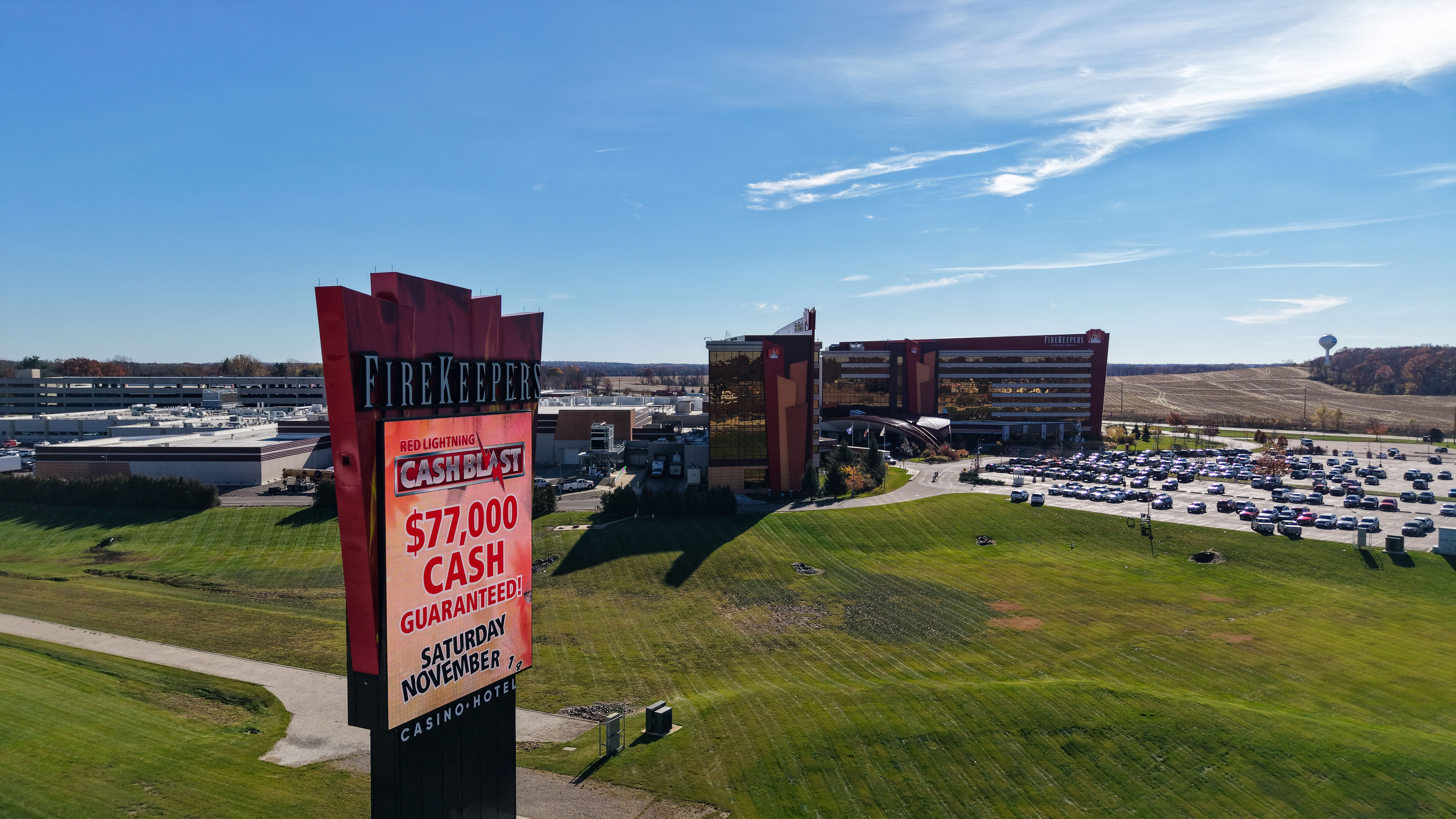
But several tribes have stopped paying over the years since online gaming was legalized in 2019, with one of the largest contributors, the Nottawaseppi Huron Band of the Potawatomi, ceasing payments in 2025, and two others dropping off in 2025 and 2026, according to state gaming revenue data. The 2024 payment from the Nottawaseppi tribe, which runs FireKeepers Casino and Hotel along I-94 near Battle Creek, was $18.5 million.
The NHBP tribal council said in a statement that it tried to renegotiate its compact with the Whitmer administration, but the request was deferred to the incoming Benson administration.
The tribal casinos appear to have continued paying a percentage in local revenue sharing, also required under their gaming compacts, and have continued paying taxes on internet gaming and sports betting platforms licensed through their casinos.
But the continued erosion of the Michigan Strategic Fund revenue stream finally caught up with the state in September, when the MEDC cut 15% of the jobs within the organization due to a shortfall created in large part by the tribal casino revenue issue. The Legislature, which has criticized the MEDC’s performance, has also made cuts to the agency, but those budget reductions have mostly been programmatic and not operational.
“The difficult decision to execute a workforce reduction is a result of declining corporate revenue, not a reflection of the important contributions of MEDC staff members who have dedicated years of honest, ethical, and deeply committed work to this organization and the more than 10 million Michiganders we serve,” MEDC CEO Quentin Messer said in September.
Republican former Gov. Rick Snyder said there were “discussions” with the tribes during his eight years in office about their contributions to the state’s economic development fund and how to limit some gambling activities, such as the iLottery, from infringing on the tribes’ gambling activities.
“I think we were successful in terms of working through it with the tribes in a positive, constructive way when I was governor,” Snyder said in an interview. “I can’t speak to what’s happened over the last few years.”
Snyder’s years dealing with the tribes came before the legalization of online gaming.
The year after he left office, Whitmer and the then-Republican-led Legislature legalized online gaming and online sports betting, some of which is licensed through the tribal casinos. The 2019 legalization and 2021 implementation of the online options have exceeded performance expectations and ranked Michigan among the top states in the nation for iGaming. Some tribes argue the popular new betting options, as well as iLottery and a proliferation of unregulated online gambling and prediction markets, have created competition that violates the exclusivity Michigan promised.
“These digital-gaming competitors are infringing on the bargained-for exclusivity promised in our compact,” the tribal council for the Nottawaseppi Huron Band of the Potawatomi said in a statement.
“Despite NHBP initiating discussions, the current administration decided not to renegotiate and, instead, to have the next administration address it,” the council added.
Tribal payments not a way to fund MEDC budget, ex-CEO says
The gaming compacts in question were made between the tribes and past governors. Attorney General Dana Nessel’s office, when asked about the tribal casino payments, directed questions to Whitmer’s office, which declined comment.
Over the years, the tribal casinos have made up a big portion of the MEDC operational budget while state taxpayer funding appropriated through the Legislature has largely contributed to programmatic spending.
During the 2026 fiscal year, the MEDC budgeted $62.1 million in tribal casino revenue as part of an overall operations budget that anticipated $74.1 million total in revenue, according to the MEDC’s online budgets. The total expected tribal casino revenue included dollars generated through online gambling options, revenue that has not stopped.
The MEDC commonly refers to the tribal casino revenue as part of its “corporate” funds, separate from general taxpayer support for the state’s business-attraction agency. The corporate budget includes agency fees and investment earnings.
According to state gaming data, about $15.4 million in tribal gaming fees from Class III games flowed into the agency in 2025 and $304,000 was collected in 2026. In 2024, the number stood at $39.4 million.
The MEDC, when asked about the waning tribal casino fees this month, said the revenue is an “important component of the MEDC budget,” but the agency can operate without it.
Steve Arwood, a former MEDC CEO, said the agency experienced a similar stoppage in some tribal casino payments while he led it between 2015 and 2017. At the time, the agency faced a significant budget cut that resulted in layoffs, but it was eventually curbed through further negotiations with the tribes, Arwood said.
It’s a delicate funding stream that can’t be recouped as easily as typical tax revenue, Arwood said, “an area that requires relationship over law.”
Given the sensitivity of the funding stream and the fact that there is no easy way to resolve the tribes’ concerns about online gambling, Arwood had his doubts about the MEDC’s future reliance on the tribal gaming fees. He speculated that the individuals who created the funding model a few decades ago likely did not envision Michigan’s current gambling landscape.
“If you’re going to have some sort of revenue stream to support economic development, this is probably not it,” Arwood said. “As a matter of fact, I know it’s not it.”
Aside from the Nottawaseppi, five other tribes have stopped paying over the last eight years, according to state gaming data.
The Little Traverse Bay Bands of Odawa Indians stopped its payments in 2018, the Keweenaw Bay Indian Community in 2021 and the Little River Band of Ottawa Indians in 2023.
The Gun Lake Tribe, which is listed in state data as having contributed $3.1 million in 2025, stopped payments at the end of January 2025. The Pokagon Band of Potawatomi, which paid $11.6 million in 2025, is not listed as contributing in 2026.
The Hannahville Indian Community is the only tribe listed as paying the fee in 2026 — roughly $304,000.
Why the tribes are stopping payments
The Gun Lake Tribe, which operates Gun Lake Casino Resort in Wayland, noted that the gaming landscape in Michigan “changed dramatically” following the legalization of online sports betting and gaming. Since then, the number of illegal online gaming sites and prediction markets has also grown.
Just last month, the Michigan Gaming Control Board announced it had issued 32 cease-and-desist letters to offshore gambling operators believed to be offering unregulated sports betting, online casino games and sweepstakes in Michigan. “Online casino players are increasingly crossing into the illegal market,” the gaming regulators said in a statement.
All of those options, the tribal council argued, compete with other casino gaming operations that the state was supposed to protect. The gaming compacts the tribes made with the state years ago require Michigan officials to provide “substantial exclusivity from gaming expansion in exchange for revenue sharing payments” with the MEDC, the tribal council said.
The compacts have been tweaked as the Detroit casinos came onto the scene in 1999 and 2000 or the state iLottery emerged, but, the council argued, the 2019 legalization of online gaming and sports betting has ushered in dramatic changes.
“Because the gaming expansion was permitted by the state of Michigan, Tribes are no longer receiving substantial exclusivity and therefore are no longer legally obligated to share revenue with the state of Michigan under the terms of the contracts,” the Gun Lake tribal council said in a statement. “We will always seek collaborative solutions with the state while continuing to share revenue with our local communities to support institutions such as schools, local governments, local law enforcement, and emergency responders.”
The Nottawaseppi tribe noted there is an imbalance in the state having the tribal casinos pay the Strategic Fund fee while outside iGaming competitors do not, “despite disrupting the tribes’ exclusivity rights, diluting the market, and capturing massive revenue streams.”
“NHBP, for the first time, is following the action of other Michigan tribes, who have ceased payments for multiple years,” the tribal council said in a statement. “Tribes have experienced the severe negative impact of iGaming, which is mainly driven by operators outside of Michigan, plus the impact of prediction markets and iLottery offerings that mirror iGaming.”
The Little River Band of Ottawa Indians stopped payments in 2023, after Whitmer blocked a proposed off-reservation casino near Muskegon, even after the federal government approved the plan.
Larry Romanelli, an ogema or tribal leader with the Little River Band, said the group had invested millions of dollars into the proposal over 16 years.
“We were trying to be reasonable and work within the compact and do what we should be doing,” Romanelli said. “And it just did not seem to be going through the way it should from the state side. So we decided to hold the money.”
eleblanc@detroitnews.com
This article originally appeared on The Detroit News: Tribal casinos stopped paying millions to state. MEDC layoffs ensued
Reporting by Beth LeBlanc, The Detroit News / The Detroit News
USA TODAY Network via Reuters Connect

Little River among tribal casinos halting millions in state payments, sparking MEDC layoffs added by admin on
View all posts by admin →