

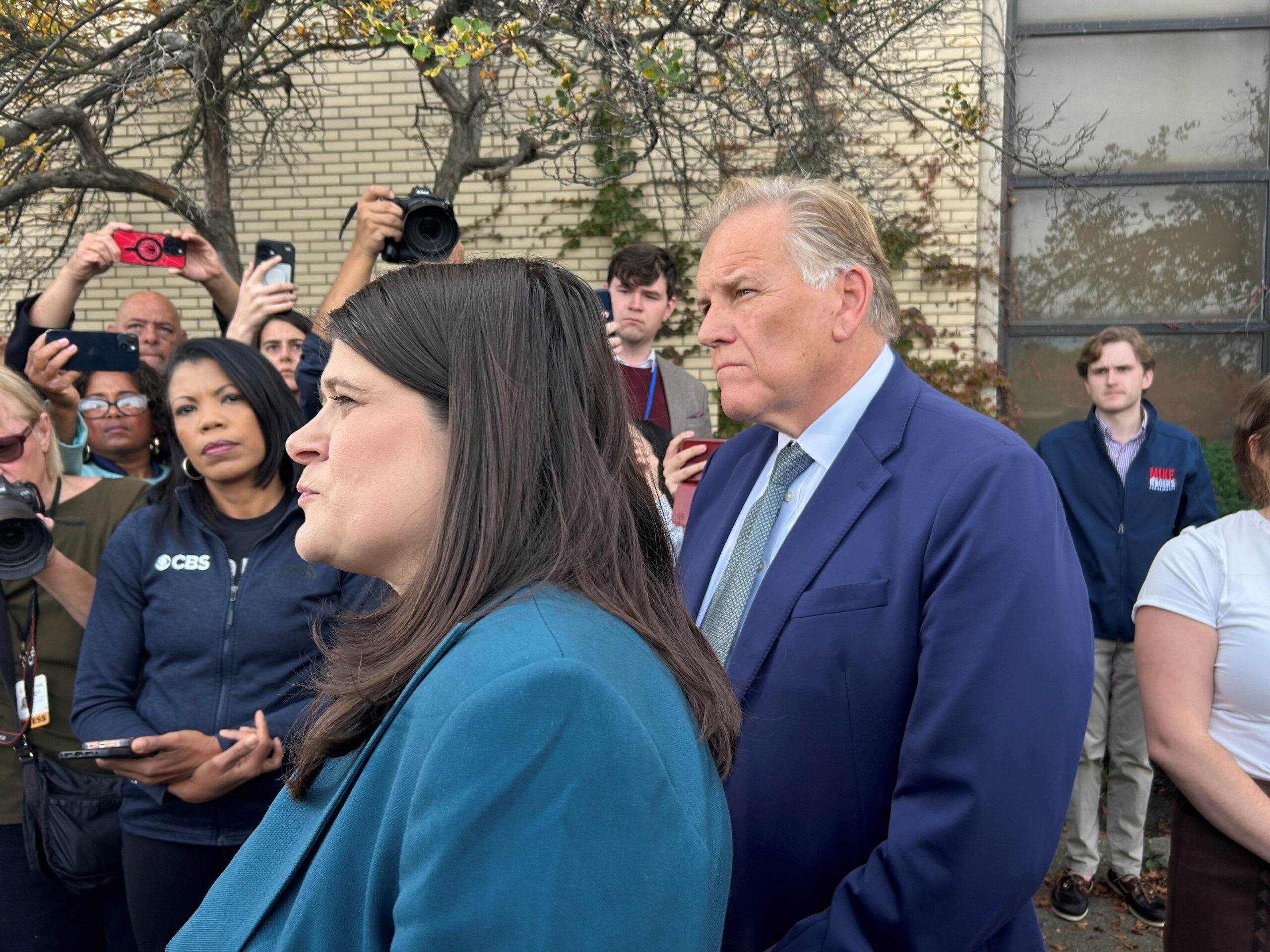
Democratic U.S. Rep. Haley Stevens’ decision on Nov. 1 to endorse Republican Mike Rogers for Michigan’s open U.S. Senate seat came as a momentous shock, not just because she had previously supported her party’s nominee, Abdul El-Sayed, but also because she had been a persistent critic of Rogers and the Trump administration.
Both prior to and after Stevens, of Birmingham, lost her bid for the Democratic nomination to the Senate seat in August to El-Sayed, she had repeatedly insisted on the importance of her party retaining the seat as a check on President Donald Trump’s agenda, criticized Rogers as a “rubber stamp” to that agenda, and insisted he was wrong for Michigan, which hasn’t elected a Republican U.S. senator since 1994.
That all apparently went out the window outside an east side Detroit church on Sunday, two days before the Nov. 3 election, for a seat that could help determine which party gets majority control of the Senate.
Stevens essentially gave two reasons for her decision: One, she felt disrespected because El-Sayed hadn’t involved her more in his campaign, despite the fact that that’s not all that unusual for rivals who spent a tough primary season bashing each other. Two, she believed he still hadn’t done enough to denounce ads from other sources and his own campaign’s rhetoric suggesting that money spent supporting Israel would be better spent in the United States on education, health care and fighting inflation, that some Jewish Democrats consider antisemitic.
“He didn’t need me there, that he didn’t want me there. And at some point, you got to look at who’s standing for country, you know?” Stevens said.
Here’s a brief rundown of some other instances, however, where Stevens’ position was clearly at odds with Rogers’ and left no indication that there was room for him to be an acceptable alternative to a Democratic U.S. senator, contrary to what she firmly claims now.
Abortion
This is a big one: The Democratic Party has been nearly monolithic in recent years in its support of abortion rights for women, and Stevens, who flipped a seat previously held by Republicans in 2018, has been a consistent advocate for women’s rights. When she ran for reelection in a newly drawn district in 2022 against Democratic U.S. Rep. Andy Levin, she even suggested she might be more committed to that issue than he was — which was false — because he is a man.
But Rogers, while having said he respects Michigan’s statewide referendum protecting abortion rights, has been a staunch anti-abortion vote in Congress, as recently as last week pointing to his “100% pro-life rating” in an interview.
Union rights
Stevens failed to get the backing of the UAW ahead of the Democratic primary in August, which went to El-Sayed. But she still received lots of other union endorsements, including those form several Teamsters groups, and she has been a longstanding supporter of the right to organize and labor rights.
Rogers, like many members of his party, generally voted against expanding organizing rights and labor protections when he served in Congress and has a 11% lifetime score on the AFL-CIO’s scorecard of support for its priorities.
Election denial
This is actually a case where both Stevens and Rogers can be taken to task for making apparently contradictory claims. Stevens has consistently bashed President Trump and his allies for making repeated and false claims of widespread corruption and fraud in elections, including in Michigan, where there is no evidence of such pervasive issues. She said Rogers was “an election denier” and accused him of spreading “election conspiracy theories that undermine our democracy,” calling him “wrong for Michigan.”
Rogers, paradoxically, at the time criticized Trump’s claims that the 2020 election which he lost was fraudulent, but has since repeated unproven claims of vote rigging and corruption in Michigan’s elections.
Health care
Rogers has been critical of government taking a bigger role in providing and guaranteeing health care generally and voted against the Affordable Care Act, otherwise known as Obamacare, when in Congress.
Stevens wasn’t in Congress at the time, and she hasn’t embraced a single government-run health care plan for all Americans as El-Sayed has. But she has been a consistent supporter of the ACA and the expansion of access to health care, and she has criticized cuts to Medicaid and other health programs embraced by Republicans under Trump.
Trump’s agenda
Stevens has been a persistent critic of Trump’s agenda to slash government, cut overseas aid and employ harsher methods of immigration control inside the United States. And she has been a critic of the continued war in Iran and Trump’s tariff agenda as hurtful to Michigan businesses.
Rogers had voiced no opposition to the Trump agenda, until recent weeks just before the election when he suggested the war be ended quickly and a trade war with Canada be curtailed. It’s still unclear how much of a check Rogers would be on Trump, however, given that the president has endorsed him and Rogers has continued to campaign with Trump.
Stevens had also made a priority of vociferously criticizing some members of Trump’s Cabinet, most of all Health and Human Services Secretary Robert F. Kennedy Jr., who she wanted impeached.
Rogers recently campaigned with RFK Jr., who made remarks some considered bigoted about Arabs, saying they didn’t win global awards. (They do.)
Contact Todd Spangler: tspangler@freepress.com. Follow him on Twitter @tsspangler.
This article originally appeared on Detroit Free Press: 5 issues Haley Stevens disagreed with Mike Rogers on in the past
Reporting by Todd Spangler, Detroit Free Press / Detroit Free Press
USA TODAY Network via Reuters Connect

5 issues Haley Stevens disagreed with Mike Rogers on in the past added by admin on
View all posts by admin →