

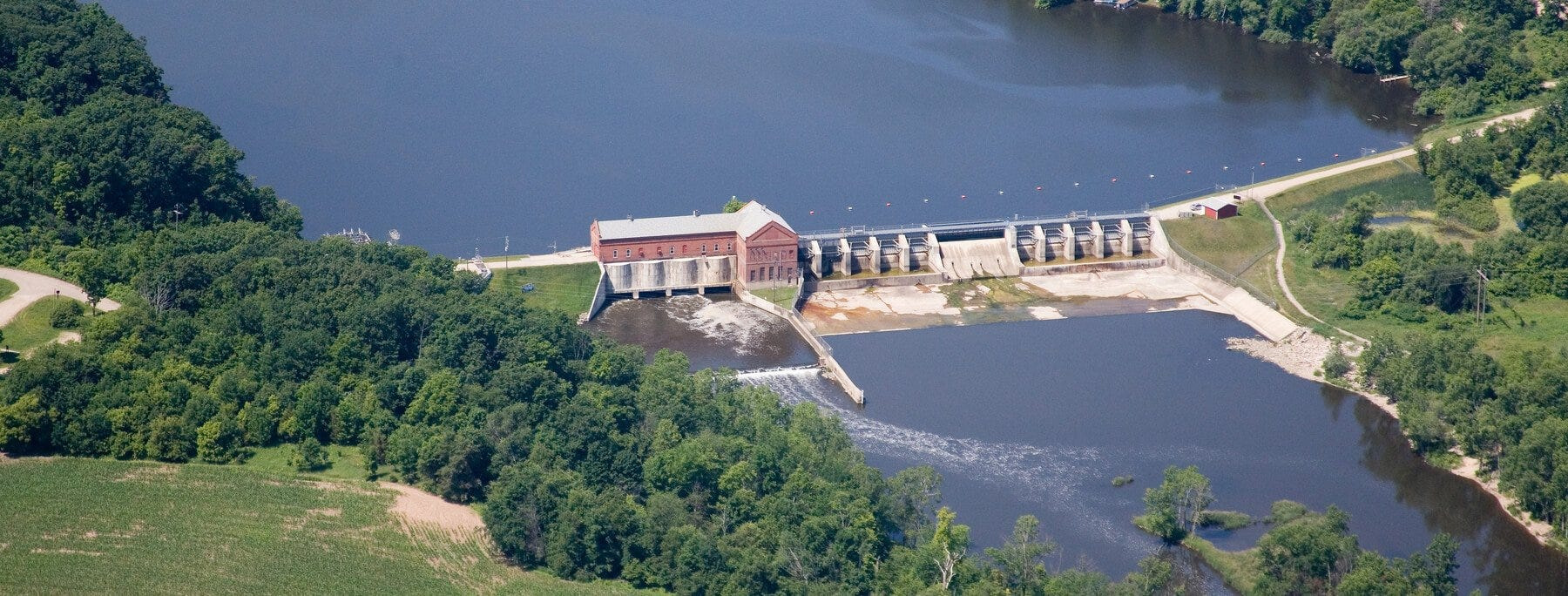
Local officials in communities surrounding 13 Consumers Energy hydroelectric dams expressed support for a plan to allow the utility to sell the aging dams to a Maryland private equity firm rather than decommission and remove them — a move that would dramatically change the lakes and ponds they’ve built their lives around.
The Michigan Public Service Commission extended its deadline to make a decision on Consumers’ proposed sale of the dams by 60 days in September, as Gov. Gretchen Whitmer, state Attorney General Dana Nessel and the Michigan Department of Natural Resources expressed opposition to the sales, contending moving the responsibility of the dams to a private equity firm leaves too much uncertainty on maintenance and safety issues.
But local residents and officials, in a news conference Tuesday, Oct. 27, said the impoundments the dams have created for a century or more are ingrained in life and the local economy. James Ward — founder of the grassroots Hardy Pond Preservation Alliance, which seeks the preservation of the Hardy Dam on the Muskegon River in Newaygo County — talked about the aspects of local life connected to the dam’s impoundment.
“We are talking about 2,000 campsites on seven campgrounds,” he said. “We are talking about 450-plus docks on the pond … businesses that are depending on the reservoir, the 100,000 mountain bikers that bike the Dragon Trail. All the business that’s brought by campers, boaters, all the residents who live around the reservoir.”
Jakob Veith, superintendent of Kaleva Norman Dixon Schools and Bear Lake Schools in Manistee County, told a similar story about the significance of the Tippy Dam near Wellston and Brethren and the Hodenpyl Dam on the Manistee River in Manistee and Wexford counties.
“The hydro dams we are talking about today are critical to the continued success of our community,” Veith said.
“The reservoirs created above the dams offer incredible opportunities to canoe, kayak, fish and camp in northern Michigan. And below Tippy Dam is a world-class salmon and steelhead fishing destination site. Our local economy depends on these recreational opportunities.”
Tuesday’s news conference with the dam area residents was organized by Byrum and Fisk Advocacy Communications, a public relations firm working with Confluence Hydro LLC, a subsidiary of Bethesda, Maryland-based private equity firm Hull Street Energy LLC.
Consumers Energy seeks to sell its 13 dams to Confluence for $13. The sale would include a power purchasing agreement by which Consumers would commit to buy back power from Confluence at a starting rate of $160 per megawatt-hour — approximately double the going market rate for comparable hydropower. The 30-year agreement includes a 2.5% annual price increase.
The dams proposed for sale include:
- The Allegan Hydro Dam on the Kalamazoo River in Allegan County
- The Webber Dam on the Grand River in Ionia County
- The Rogers Dam on the Muskegon River in Mecosta County
- The Hardy and Croton dams on the Muskegon River in Newaygo County
- The Hodenpyl Dam on the Manistee River in Manistee and Wexford counties
- The Tippy Dam on the Manistee River in Manistee County
- Six dams on the Au Sable River: the Mio Dam in Oscoda County; the Alcona Dam in Alcona County; the Loud Dam in Iosco and Oscoda counties; and the Five Channels, Cooke and Foote dams in Iosco County
The dams were built between 1905 and 1936 and have generated power for Consumers Energy customers for more than a century on average, according to the utility’s filings with the Michigan Public Service Commission. But aging dams need ongoing, expensive maintenance, and the costs of generating hydropower have increasingly become uncompetitive.
The proposed sale to Confluence Hydro “allows Consumers Energy to transfer substantial future operational and environmental liabilities and risk to Confluence,” utility officials stated in their MPSC filing, adding that it “is the lowest-cost option for the future of these plants.”
“The transaction also benefits the state of Michigan and numerous local communities where the facilities are located by preserving the dams and related impoundments, which provide important economic and recreational benefits in those communities and to the state.”
Confluence Hydro spokeswoman Natalie Joubert, in an earlier statement to the Free Press, said the company specializes in the safe and efficient operation of hydroelectric dams.
“We plan to own, operate and relicense all 13 dams to ensure they continue to provide safe, clean power, recreation, and economic benefits for local communities for decades to come,” she said.
Should state regulators reject the dam sales, Consumers Energy “would proceed to the next lowest-cost option, which is decommissioning and removal of the dams,” utility spokesman Brian Wheeler earlier told the Free Press.
Nessel in July reversed her office’s tentative support for the dam sales.
“Our deep concern is just how private equity operates,” she said. “They buy an asset, they make some money off it, and then they flip it off to a new buyer. And when it comes to these dams, some of which are almost 100 years old, it’s just extremely frightening to us. Dams are powerful, and they can be extremely dangerous when they are not maintained well.”
Michigan’s recent history includes an example: the May 2020 failure of the Edenville and Sanford dams on the Tittabawassee and Tobacco rivers in Midland and Gladwin counties. The private owner of the dams, Boyce Hydro LLC, had its power generation license revoked by the Federal Energy Regulatory Commission less than two years earlier for repeated compliance violations, including the Edenville Dam’s inadequate spillway capacity to handle major probable maximum flood events.
After nearly 5 inches of rain fell within two days in May 2020, the Edenville Dam failed, sending a wall of water that also caused the Sanford Dam downriver to fail. Widespread flooding that ensued in Midland and Gladwin counties forced the evacuation of tens of thousands of people, and the flooding caused more than $200 million in damage.
Boyce Hydro Power LLC filed for Chapter 11 bankruptcy in mid-2020, shortly after the dam failure. A U.S. district judge in November 2023 found Boyce principal Lee Mueller liable for $119 million in environmental damage caused by the dam failure. A U.S. Bankruptcy Court judge in Nevada denied Mueller’s attempt at a personal Chapter 13 bankruptcy in February 2024, finding he misrepresented facts before the court and that his effort “smacked of bad faith.” Boyce and Mueller’s liabilities to creditors remain unresolved.
Consumers and Confluence officials, however, push back on comparisons to that situation, noting their own records of operating hydro dams safely. The utility and equity firm this summer announced establishment of a $270 million Hydro Safety Fund “to protect Michigan communities in case of unforeseen safety issues after Confluence Hydro takes ownership.”
Fred Lewis, supervisor of Plainfield Township in Kent County, said he has confidence that safety and maintenance of the dams will be maintained after an ownership transfer.
“We the people who live here are more concerned than anybody is about whether these dams are going to continue to be operated in a safe and efficient manner,” he said.
A number of environmental and conservation organizations support the MPSC rejecting Consumers’ sale of the dams — and advocate for environmental reviews or potential river restoration to natural flows. These groups include Michigan Trout Unlimited; Anglers of the Au Sable; Great Lakes Council of Fly Fishers International; Michigan Steelhead and Salmon Fishermen’s Association, and the Michigan League of Conservation Voters.
Ward said residents around the dam impoundments probably haven’t been heard in Lansing as loudly and clearly as those anglers groups.
“The idea that [Hardy Dam] would just go away, there’s just disbelief,” he said. “There hasn’t been a lot of voices that have come out” on approving the dam sales and preserving the dams “until more recently, when it’s become a more stark reality that this is something that could go away.”
Contact Keith Matheny: kmatheny@freepress.com.
This article originally appeared on Detroit Free Press: Residents near Consumers dams support their sale to save lakes, ponds
Reporting by Keith Matheny, Detroit Free Press / Detroit Free Press
USA TODAY Network via Reuters Connect

Residents near Consumers dams support their sale to save lakes, ponds added by admin on
View all posts by admin →