

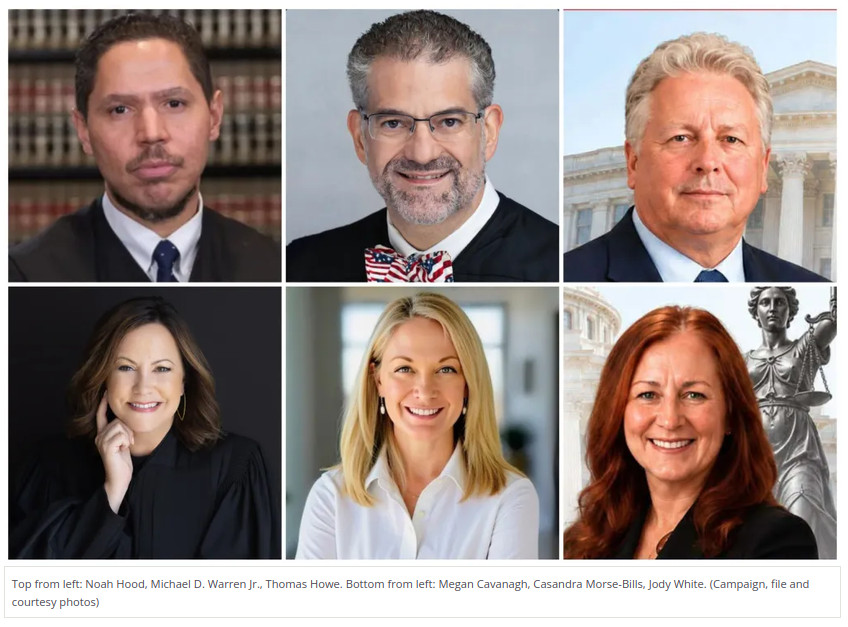
Who’s running for Michigan Supreme Court? 6 candidates compete for 2 seats
This story was originally published by Bridge Michigan (bridgemi.com), a nonprofit and nonpartisan news organization. To get regular coverage from Bridge Michigan, sign up for a free Bridge Michigan newsletter here
- Six candidates are competing for two seats on the Michigan Supreme Court
- Incumbent justices Megan Cavanagh and Noah Hood are nominees of the Michigan Democratic Party, which now holds a 6-1 edge
- Republican nominees Casandra Morse-Bills and Michael D. Warren Jr. hope to narrow that partisan gap
Two Michigan Supreme Court seats are up for grabs in the Nov. 3 general election, giving Republican nominees a chance to oust Democrat-nominated incumbents and narrow the large liberal majority on the state’s highest court.
The Michigan Supreme Court often has the final say on issues of critical importance, including whether laws enacted by the state Legislature are constitutional or whether ballot measures should go before voters.
Although Supreme Court elections in Michigan are nonpartisan, candidates’ nominations are a political process, with delegates at state party conventions determining who advances to the November ballot.
Currently, six of the court’s seven sitting justices have been appointed or nominated by Democrats.
The court has in recent months made several precedent-setting decisions on criminal law, including limits on the constitutionality of mandatory life without parole sentences and a ruling declaring the state’s sex offender registry law unconstitutional if applied retroactively.
Related:
- Who are the Michigan State Board of Education candidates? What to know.
- Absentee ballots going out in Michigan: What to know
- Proposal 1: Rewrite Michigan’s Constitution? Here’s how it would work
The latter decision has already resulted in the removal of more than 20,000 people from the list.
The court also adopted a rule this year aiming to limit the ability of law enforcement officers to make civil arrests — including immigration arrests of suspected noncitizens — in state and local courtrooms.
Both major political parties nominated candidates at conventions in late August. They’ll compete for two eight-year terms.
For Democrats, Chief Justice Megan Cavanagh and Justice Noah Hood are seeking reelection. Republicans selected circuit court judges Casandra Morse-Bills and Michael D. Warren Jr. to challenge the incumbents — and the court’s liberal supermajority.
While down-ballot races can garner less attention, Democrat-nominated incumbents have already spent more than $740,000 on television ads to try to secure reelection, according to the Brennan Center for Justice. Separately, the ACLU Voter Education Fund is spending about $400,000 in Michigan’s Supreme Court elections.
That’s a continuation of a multiyear effort by supporters of Democratic-nominated court candidates to first flip and then maintain the court’s ideological bent.
The US Taxpayers Party also nominated two candidates, Thomas Howe and Jody White, to compete for the seats. Neither candidate is licensed to practice law in Michigan, a requirement for assuming office that doesn’t prevent them from appearing on the ballot or campaigning
During a recent forum hosted by the League of Women Voters, the six candidates shared more about their backgrounds, judicial philosophies and how they would approach the position if elected.
Here’s what you need to know.
Megan Cavanagh, Democratic nominee
First elected to the court in 2018, Cavanagh graduated from Wayne State University Law School and worked as an appellate attorney. Before shifting to the legal field, she worked as a consultant in environmental engineering.
She was unanimously selected as the Michigan Supreme Court’s chief justice in March 2025. Her father, Michael Cavanagh, served on the court from 1983-2015 and was chief justice from 1991-1995.
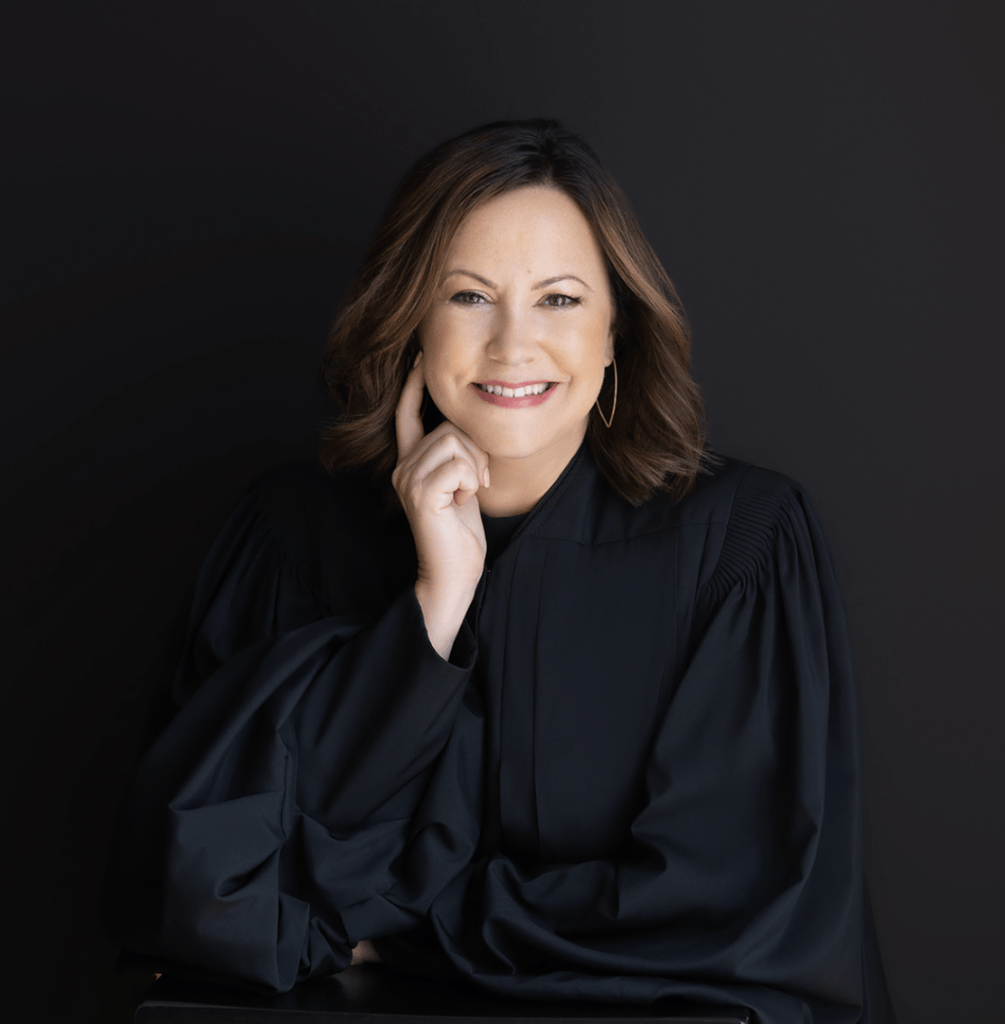
Cavanagh authored the landmark Bauserman v. Unemployment Insurance Agency decision in 2022, which held that Michigan residents can sue the state for damages if their constitutional rights are violated.
Other notable opinions by Cavanagh include Pueblo v. Haas, which held that unmarried LGBTQ partners denied the right to marry under Michigan’s former same-sex marriage ban have legal standing to seek child custody and parenting time, and People v. Jennings, which expanded Michigan’s double jeopardy protections beyond a narrower federal standard.
During the forum, Cavanagh said that in addition to deciding cases, her focus on the court has been to expand access to justice, improve child welfare outcomes, strengthen legal representation for families and build meaningful collaboration with the state’s tribal courts.
“My judicial philosophy is that the law should be able to be fairly understood by citizens who are required in our society to comply with it, to structure their affairs in accordance with it and to rely on the protections afforded by it,” she said. “The law does not exist to serve dictionaries. It exists to serve citizens.”
Cavanagh said she views access to justice as the biggest problem currently facing the court, pointing to efforts justices have taken in recent years to revamp court forms and make the state’s legal system easier to navigate and understand.
She argued that the court should be “very cautious” about deciding political questions, noting that the court has increasingly been called upon to decide politically fraught issues “that should be resolved by other branches” as society becomes increasingly polarized.
Noah Hood, Democratic nominee
Hood, of Detroit, was appointed to the bench in April 2025 by Democratic Gov. Gretchen Whitmer to fill the remainder of former Chief Justice Elizabeth Clement’s term.
A graduate of Harvard Law School and Yale, Hood previously served on the Third Circuit Court and Michigan Court of Appeals. His mother is former federal Judge Denise Page Hood, and his father, Rev. Nicholas Hood III, previously served on the Detroit City Council.
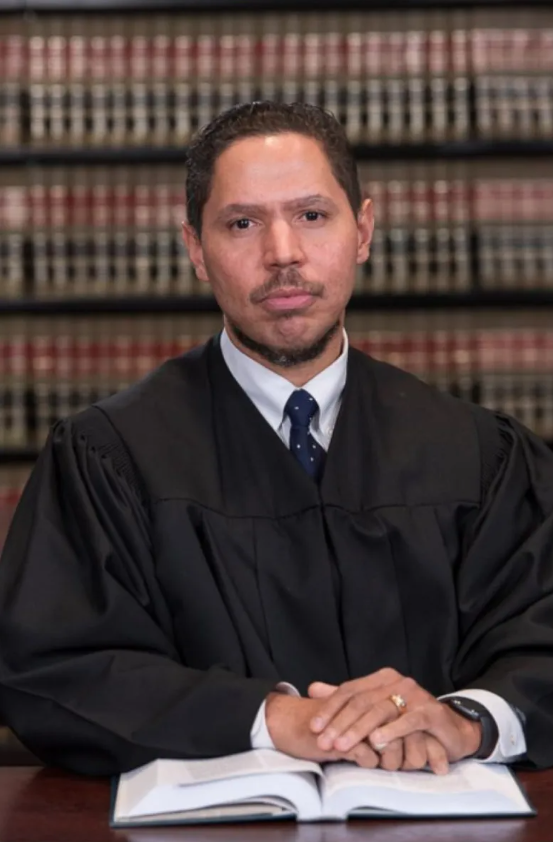
This month, Hood authored a 4-3 majority opinion in Attorney General v. Eli Lilly, reversing two past court decisions that limited enforcement of the state’s Consumer Protection Act in cases of deceptive business practices and price gouging.
The ruling allowed Attorney General Dana Nessel to proceed with an investigation of Eli Lilly and Company’s insulin pricing practices and has broader implications for future use of the consumer protection law.
Pointing to his experience serving as a trial and appellate judge as well as his time on the Michigan Supreme Court, Hood said he is “uniquely well-suited” to see the choke points in the legal system and serve on the state’s highest court.
“I am probably the only person in this country who has had the experience of representing a juvenile lifer as a defense attorney…resentencing them as a trial judge, correcting their sentences as an intermediary public judge, and now interpreting what our Constitution says about the validity of those sentences as a Supreme Court justice,” he said in the candidate forum.
Hood described his ideology as fact-based and methodical, looking for trends and themes that emerge from past cases. Asked whether politics has an impact on the court’s decisions, he said that it does, arguing that justices under the state’s past conservative court majorities “did do a lot of legislating from the bench” and that the court’s current approach is a “return to the normal way a court should operate.”
He said he views the imbalance of resources between courts around the state as the biggest problem currently facing courts and something that “permeates every level of our judiciary.”
Casandra Morse-Bills, Republican nominee
Morse-Bills is a circuit court judge in northern Michigan serving Alcona, Arenac, Iosco, and Oscoda counties. She also serves on the Michigan Judicial Council.
A graduate of Cooley Law School, Morse-Bills said she’s running for the Michigan Supreme Court because “I have firsthand experienced and seen the radical changes that have occurred in our judicial system” in recent years. She argued that recent Supreme Court opinions have been “unfair, unjust and are not equal under the law.”

“Judges are here to follow the law and to uphold the Constitution,” she said. “That is what I have always done as an attorney and as a sitting judge, and that is what I will continue to do.”
As a judge, Morse-Bills has presided over many cases. Last year, in one high-profile case, she sentenced a man to 25-60 years for first-degree criminal sexual assault.
Morse-Bills previously worked as Oscoda County prosecutor and in 2020 was sued over her failed prosecution of two residents who had tried to remove a neighbor’s shed they believed to be on their property. A federal judge dismissed the case in 2022, ruling Morse-Bills had governmental immunity.
Morse-Bills described herself as a rule-of-law judge and said she would “absolutely avoid” party politics or influence of political agendas on decisionmaking in the courtroom. She said one of her biggest priorities if elected would be to restore trust in the judicial system.
Michael D. Warren, Jr., Republican nominee
Warren has served on the Oakland County Circuit Court for more than 23 years, overseeing more than 400 jury trials during that time.
Since his 2002 appointment by then-Gov. John Engler, Warren has overseen criminal, family, civil and business court cases and won reelection five times. He was also an early adopter of e-filing and paperless courtroom systems, piloting a court e-filing project as early as 2004.

A graduate of the University of Michigan Law School, Warren has taught legal courses and is also an author and the founder of Patriot Week, an effort to encourage civic engagement during the week between 9/11 and Sept. 17, the anniversary of the Constitution’s signing. Prior to his work as a judge, Warren served on the state Board of Education.
If elected, Warren said he would bring a “depth of experience that is really needed in our Supreme Court,” noting that the current ideological split of the court is “very unbalanced.”
In addition to his nomination by the Republican Party, Warren said he’s also been endorsed by the Libertarian Party.
As a judge, he said the ideal role is “not to put the thumbs on the scale of justice, but to apply the law fairly and impartially based on what the law says” and is concerned by any implication that politics should play a role in the court’s proceedings.
Warren said his two primary concerns with the current court system are overworked, overextended judges in many of the state’s trial courts that are resulting in delays of justice and the six-to-one ideological split on the bench.
“Five of the seven justices have not been a judge before, and there’s a fundamental divide between the proper role of the court,” he said. “I believe that the courts should not be actively looking to implement policy and to aggressively change prior precedent, and that’s not the situation that we’re in today.”

Thomas Howe, US Taxpayers nominee
A retired engineer, Howe said he is running to serve on the Michigan Supreme Court in part because of his experience advocating for his mother’s legal rights and assets in court.
He described the state’s current legal system as a “playbook from hell” designed to maximize attorney payouts.
If elected, Howe said during the forum, he would advocate for an artificial intelligence-driven court audit system to prevent corruption and “rebuild discipline” on the bench.
Howe does not have a law degree, which complicates his bid for the court. The state Constitution requires an active law license and at least five years’ experience in the field to serve, though a lack of qualifications doesn’t prevent someone from being nominated or running for the post.
During the forum, Howe argued that his engineering background and years of personal experience with litigation “prepare me to turn courts around to root out all the corruption the bar fails to address.”
Jody White, US Taxpayers nominee
White, a real estate broker, said she was inspired to run for the Michigan Supreme Court after her family became involved in the courts, a process that made her question whether the legal system had appropriate checks on whether its administrators follow the rules.
She said during the forum that she’s seen firsthand “how hard it can be to get a timely answer when something goes wrong,” noting that she’s spent years collecting documents and listening to others who have been through the system.
Like Howe, White does not have a law degree, which is a requirement to assume office if elected to the court.
Despite her lack of formal qualifications, White said her real estate experience has prepared her to follow the evidence and make Michigan’s existing legal protections work for the people who need them.
As a judge, White said she would “listen to both sides, examine the record and explain my decision in language people can understand.”
This article first appeared on Bridge Michigan and is republished here under a Creative Commons Attribution-NoDerivatives 4.0 International License.

Who’s running for Michigan Supreme Court? 6 candidates compete for 2 seats added by admin on
View all posts by admin →