

Lee Chatfield trial delayed again, this time over disputed expert witness
This story was originally published by Bridge Michigan (bridgemi.com), a nonprofit and nonpartisan news organization. To get regular coverage from Bridge Michigan, sign up for a free Bridge Michigan newsletter here
- Lee Chatfield’s trial was again delayed after his attorney announced an appeal over a witness
- The appeal could push the trial into 2027, after Attorney General Dana Nessel leaves office
- Chatfield was first charged in April 2024 over alleged embezzlement said to have begun in 2020
LANSING — Nearly two-and-a-half years after he was first charged, former House Speaker Lee Chatfield’s trial was delayed again Monday, after his lawyer declared she would appeal the decision to include a forensic accountant as an expert witness.
It means Chatfield’s trial — which had already faced years of delays — could be pushed until after the November election and possibly under new state leadership.
After Ingham County Circuit Court judge Morgan Cole ruled forensic accountant Michelle Gallagher would be allowed to testify at the looming trial, Chatfield’s attorney, Mary Chartier, announced they intended to appeal the decision, arguing Gallagher had insufficient experience to act as an expert witness and disputed a financial report she authored.
State prosecutors asked Cole to block the request to stay the trial pending the appeal. Assistant attorney general Dan Gunderson insisted the move was “frivolous, and no more than an attempt to further delay Mr. Chatfield’s day of reckoning.”
Attorney General Dana Nessel called the delay “outrageous and beyond unusual” in a statement, and “a shameful disservice to the Michigan public.”
Lee Chatfield, a Republican from Levering led the Michigan House in 2019 and 2020, is facing 13 felony counts, including allegedly “conducting a criminal enterprise” by using a series of political fundraising accounts to fund a Caribbean vacation and luxury purchases. Chatfield has pleaded not guilty to the charges, which could mean decades in prison. Jury selection for the trial was scheduled to begin Tuesday.
Related:
- Former Chatfield aides get probation in exchange for testimony
- Corruption trial for ex-Michigan Speaker Lee Chatfield delayed to fall 2026
- Lee Chatfield’s wife avoids prison with guilty plea in Michigan corruption probe
Cole said her hands were tied due to state court rules and she had no choice but to again pause the proceedings. Interlocutory appeals — appeals made during an ongoing case — can take anywhere from weeks to months, and given the trial has yet to start, a quick ruling is not anticipated.
If the case is delayed until 2027 — more than seven years after the alleged embezzlement began — it means the state will have a new top law enforcement officer after Nessel departs due to term limits.
Nessel, in her statement, said the court was “bending over backward to accommodate Lee Chatfield’s lawyers in their endless efforts to push this important trial past my last day in office.”
“It’s possible the case may never be tried at all if the next attorney general simply dismisses the charges for political purposes,” Nessel said, saying she didn’t believe the case would be held this year and “it’s fair to question whether the Court ever wants to hear this case at all.”
Nessel is likely to be replaced by either Democrat Eli Savit or Republican Doug Lloyd, neither of whom cast suspicion on the case in statements to Bridge Michigan.
“Since the case hasn’t gone to trial yet, (Lloyd) hasn’t been privy to all the facts and evidence, but the information made public so far is compelling,” Keith Schipper, Lloyd campaign spokesperson, said in a statement. “If the case is ongoing when Doug is attorney general, he will review it to understand all the facts and evidence and make a determination from there.”
Savit’s campaign was more reticent, declining to comment on any pending criminal case “particularly without having reviewed all the evidence.”
“As with any matter, Eli’s decisions in this one will be based solely on the facts, evidence, and the law,” Naina Agrawal-Hardin, Savit’s communication director, added.
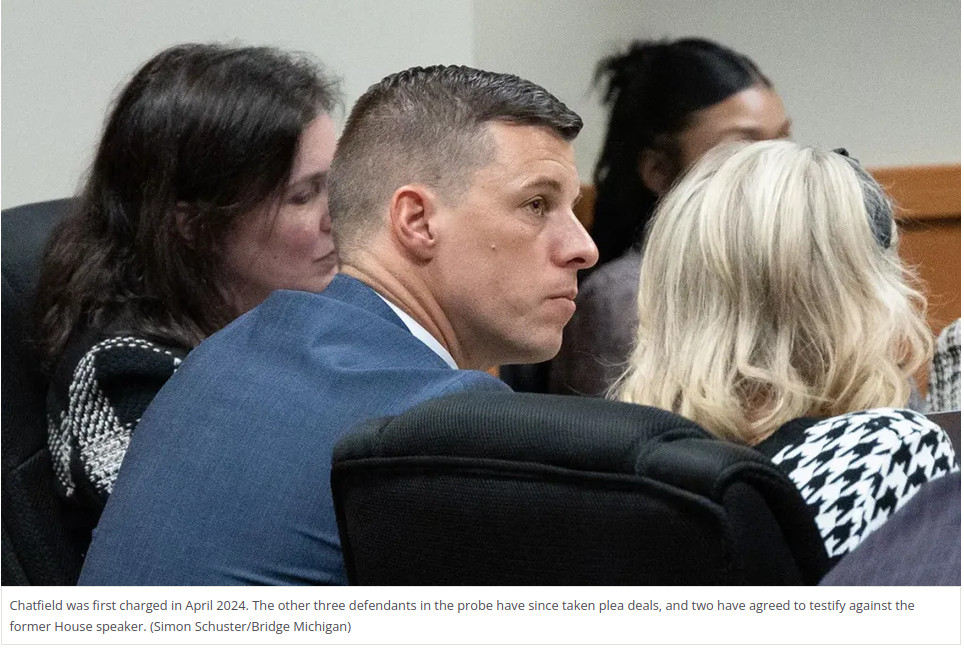
Chatfield was first charged in April 2024, and Monday’s hearing was the first public hearing after Cole last ruled to delay the trial by more than 10 months, after Chartier cited scheduling conflicts.
In a statement after the hearing, Chartier disputed any suggestion they were purposefully delaying, though conceded the appeal “will likely be months.”
“The attorney general is the one who took years to come up with these charges against Mr. Chatfield,” Chartier said. “In contrast, the defense filed its motion (to exclude Gallagher) less than 3 weeks after receiving notice that the purported expert would be called at trial.”
Chartier has previously called the case against her client a “political prosecution” that has “nothing to do with integrity,” and placed blame for any financial mismanagement on a law firm hired to review the activity of Chatfield’s primary political nonprofit, Peninsula Fund.
When the case eventually returns to her court after the appeal, Cole noted “it will be the oldest case on my docket” and said she would treat it as a “priority case.”
“Justice delayed is justice denied,” she added.
Gallagher’s role
Originally, four people had been charged: Chatfield; his wife, Stephanie Chatfield; and two of his top aides and confidants, Anne Minard and Robert Minard, who managed his political and legislative affairs.
Both of the Minards and Stephanie Chatfield have taken plea deals, and the Minards, as part of their pleas, have agreed to testify against their former boss. They all received probation, and the Minards were required to pay about $37,000 in back taxes and penalties.
Gallagher’s testimony has been relatively central to the case against Chatfield. In the preliminary examination more than 18 months ago, she provided an analysis of financial statements from the fundraising accounts, producing a report that designated whether or not individual charges could be considered permissible or questionable.
She had testified that over the span of a year from 2020 to 2021, the Chatfields charged more than $153,000 to personal credit cards, while the Peninsula Fund — which had been managed by the Minards — was used to pay off more than $152,000 of the debt.
Gallagher testified that nearly $21,700 of that was for improper expenses, including tickets to Universal Studios in Florida, a $1,353 dinner at Ocean Prime in Naples, Florida, nearly $1,000 in dry cleaning and more than $650 from the Vineyard Vines clothing company.
Probe dates back to 2021
Authorities began investigating Lee Chatfield in 2021 when his sister-in-law, Rebekah Chatfield, accused him of sexually assaulting and manipulating her for more than a decade, beginning in the early 2010s when she was a teenage student at the Christian school where he taught.
She first shared her account publicly with Bridge Michigan. Nessel, the state’s attorney general, previously said the probe failed to yield conclusive evidence of sexual assault, and Lee Chatfield characterized it as a consensual affair.
The investigation also shed light on the opaque world of nonprofit account fundraising in Michigan politics, where many elected officials have so-called “dark money” accounts which have little oversight of their fundraising and spending. Nessel has previously called for an overhaul of the state’s disclosure laws to allow less hidden fundraising.
Bridge reporter Jordyn Hermani contributed to this story.
This article first appeared on Bridge Michigan and is republished here under a Creative Commons Attribution-NoDerivatives 4.0 International License.

Lee Chatfield trial delayed again, this time over disputed expert witness added by admin on
View all posts by admin →