

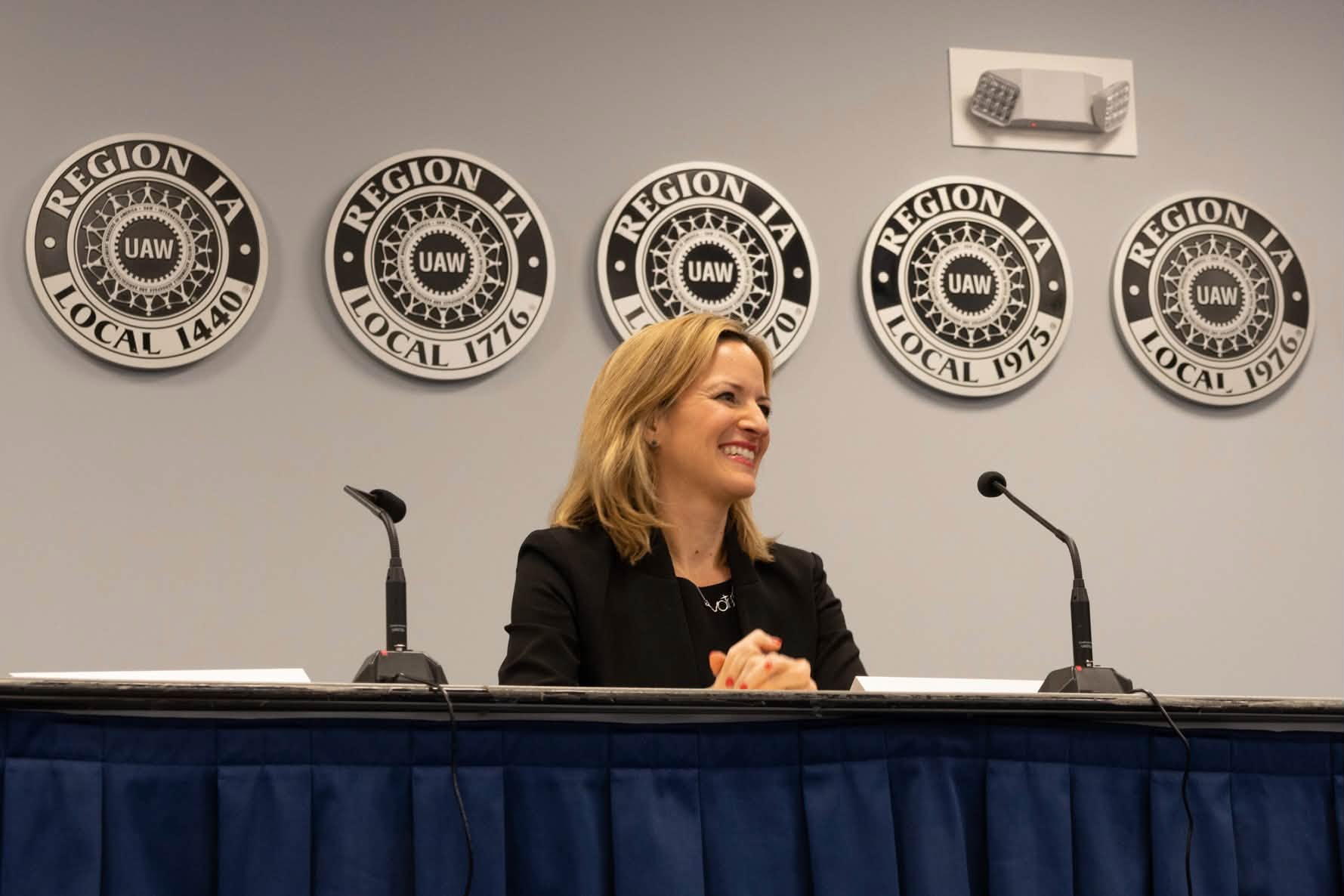
By Joseph Poulos
Now that the first Michigan gubernatorial debate is officially over, both candidates are trying to
make their positions clear before the next scheduled debate in Detroit on Oct. 15.
During the debate, the Democratic Secretary of State Jocelyn Benson and Republican U.S.
Representative John James battled on key points including tariffs, data centers, and quality of
life improvements like tax and gas relief for Michiganders.
In an exclusive interview with the Muskegon Tribune, Benson outlined her plan to eliminate the
economic animosity between Michigan and Canada.
“Our relationship with Canada is essential to our economy,” she said. “Attacking them is nothing
short of a gift to China or Russia and does nothing but hurt our residents. The next governor has
a responsibility to find ways to protect Michiganders from reckless federal policies and maintain
a positive relationship with our neighbors.”
According to Benson, Michigan families have already paid over $6,400 because of what she
referred to as “Trump’s reckless trade war.” This is money that she believes could and should
still be in the hands of loyal Michiganders, that is, if it weren’t for John James’ approval of the
tariff policy.
“John James has rubber stamped these tariffs,” Benson said. “That’s why I call them the John
James Tax. Michiganders sent James to Congress with one job: standing up for Michigan.
Instead, he has refused to speak on behalf of the people he represents, opting to do whatever
Trump asks of him – regardless of the impact it will have on his own constituents.”
Though Benson was quick to lump James in with the Trump administration, he has actually
distanced himself from party loyalty recently. James also introduced a plan this past week to
reroute federal tariff revenue to fund local businesses and manufacturers who have been
financially harmed in the trade war.
As far as Benson is concerned, it’s too little, too late. She believes she is the right candidate for
those feeling the pain of the federal government’s decision to impose these tariffs.
“I will always use every tool in my toolbox to defend Michiganders and drive down costs,”
Benson said. “That’s why as governor, I will negotiate subnational agreements with our
neighbors to lower costs, protect Michigan’s jobs, and ensure our economy is thriving.”
The truth is, Michiganders have felt the impact of these tariffs to a large extent. With the price of
a gallon of unleaded gasoline now over $4.66 on average in Michigan, many voters are
determined to choose whichever candidate will relieve the stress on their wallets the quickest.
“I’ve heard from Michiganders everywhere that life is too expensive,” Benson said. “That’s why
the central focus of my campaign is raising wages and lowering costs – starting with costs
hitting families the hardest like healthcare, energy prices, and housing costs.”
While this isn’t the only rising cost of life in Michigan, and America for that matter, it is perhaps
the one most immediately tied to the Republican Party.
“Too many Michiganders are already struggling with the high cost of living, and now, they have
to pay $5 a gallon at the gas pump,” Benson said. “My opponent voted six different times to
continue this war, including as recently as last month. I’ve called on him repeatedly to do his job,
stand up for Michiganders, and end this war – but he refuses to act. Meanwhile, I’ve called for a
suspension of the federal gas tax and I’m exploring every option available to deliver relief at the
pump for Michiganders. We must do everything we can to lower costs while James and Trump
refuse to end this expensive, reckless war.”
During the debate, James fired back on claims like these, saying that “the war in Iran needs to
be over yesterday.”
The negative characterization that Benson has drawn from James’ association with the GOP
has been a key note in her campaign to be Michigan’s next governor.
“My opponent has demonstrated time and time again that he will never stand up to Trump – not
on healthcare, not on tariffs, and not on housing,” she said. “He voted to continue the tariffs
raising the cost of everything, voted three times to raise healthcare costs for Michiganders,
voted four times to ban all of us from having a say if data centers come to our communities, and
voted six times to continue the Iran war.”
One of Benson’s main criticisms of James has been his acceptance of money from Political
Action Committees. According to the non-partisan election trackers, Local Candidates, the
James campaign has already accepted more than $230,000 from PACs.
“I am the only candidate in this race who has refused to take a cent of corporate PAC money
and is not beholden to Donald Trump or wealthy donors,” Benson said. “The next governor of
Michigan should be accountable to the people — and have a clear plan for how they will deliver.
That’s why I’ve spent the last year crisscrossing the state to share my plans to lower the cost of
healthcare, housing, utility bills, childcare, and bring a new era of transparency to Lansing.”
The topic of healthcare was an important one on the debate stage and Benson emphasized that
costs are entirely too high, causing many Michiganders to forgo medical care altogether.
“I kicked off my campaign calling healthcare the ‘defining issue’ of 2026 and with less than 30
days left in this race,” she said. “I am still the only candidate with a plan to lower medical costs.
As governor, I’ll hold our insurers and big pharma accountable and ensure people come before
profits, expand access to affordable, quality care, and tackle the critical physician shortage we
are facing.”
James has said that he would like to lower the cost of healthcare in Michigan as well. The main
difference between the two candidates in this realm is their preferred method to do so. James
has historically advocated for mandatory price transparency and increased market competition
to lower healthcare costs.
On the flip side, Benson believes that more government intervention would be best.
“Right now, too many families in Michigan are forced to make impossible choices because
healthcare is too expensive,” she said. “The federal cuts my opponent voted for three times will
only make care more costly. That’s why we need to overhaul MDHHS to ensure that no
Michigander falls through the cracks and build a system that puts patients and providers first.”
She then outlined her approach to lowering the costs of healthcare in Michigan in detail:
“I will require hospitals to show patients their costs upfront, crack down on insurance companies
who deny doctor-prescribed care, pass a $5,000 caregiver tax credit, and invest in mobile health
centers to bring care directly to communities — especially those in rural Michigan impacted the
hardest by the federal cuts. Just as I did with the Secretary of State’s office, I will overhaul the
Michigan Department of Health and Human Services from a broken system to a model of
government efficiency.”
Benson then commented on another aspect of rising costs in Michigan.
“I will also make sure every Michigander can afford to live where they work,” Benson said. “I’ll
lower housing costs by incentivizing development of starter homes and affordable units,
cracking down on corporate investors who drive up rents, and breaking down barriers to
construction. And I’ll lower utility costs by ending profit-driven rate hikes, holding providers
accountable for shutoffs, modernizing our energy grid, and launching a statewide Home Energy
Bills Relief Program to cut monthly energy costs for Michigan families. The next governor needs
to hit the ground running on Day One — and I am the only candidate ready to deliver.”
One thing both candidates were able to agree on during the debate was the need for action on
new data centers in the state. The two do disagree on the method, however, with James
favoring a pause with local discretion and Benson suggesting a moratorium centralized from
Lansing.
This last topic has been one which has hampered Benson’s campaign a bit, partially due to the
fact that her husband, Ryan Friedrichs, is a senior vice president for Related Companies, which
is currently in the process of developing a massive $43 billion data center in Saline township.
The James campaign has cited this as an example of Benson’s divided loyalties as regards the
citizens of Michigan. It should be noted that Friedrichs stepped away from all Michigan-based
projects in March, though he heavily pushed for the deal when he was part of that team.
The James campaign did not respond to multiple inquiries offering them the chance to address
Benson’s comments.
The next televised Michigan gubernatorial debate will take place in Detroit on Oct. 15 at 8:00
p.m. EST.

Benson shores up post-debate positions in exclusive interview added by admin on
View all posts by admin →