

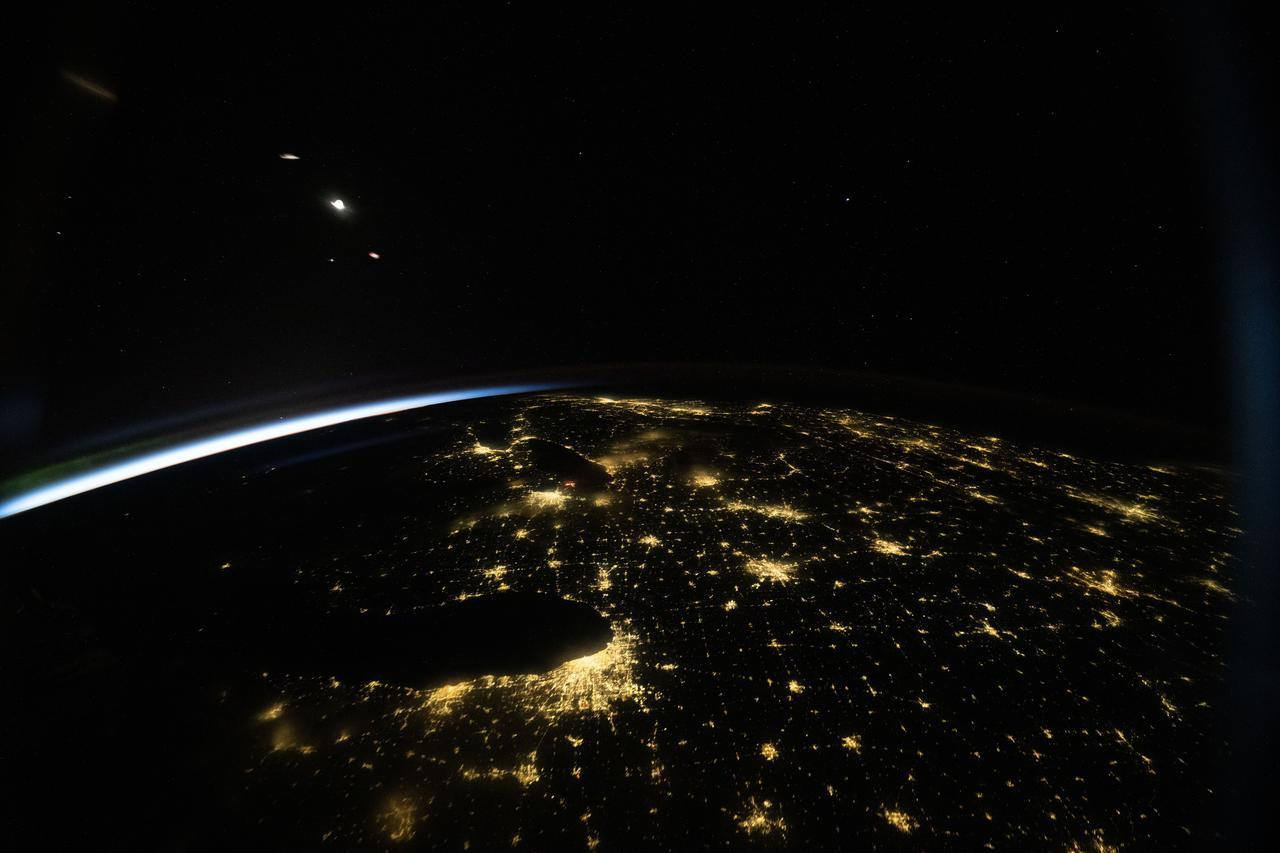
World Space Week, a global recognition of space science featuring “Rocket Revolution” as this year’s theme, is underway and Michiganders can celebrate the state’s ties to exploration in several ways.
In 1999, The United Nations General Assembly created World Space Week, annually from Oct. 4-10, in part because Oct. 4 is when, in 1957, Sputnik 1 launched into outer space as the first human-made Earth satellite.
World Space Week’s Association Board of Directors selects a new theme each year. For 2026, the focus is on rockets and the technology used to launch them.
“Rocket Revolution focuses on the rapid transformation of space launch. Once limited to a small number of government programs, access to space is now expanding through commercial launch providers, reusable rockets, university teams, startups, and new national space actors. This shift is changing who can reach space, how often launches happen, and what space is used for,” according to the United Nations World Space Week webpage.
Michigan features several space-related sites, including the former Keweenaw Rocket Range at the tip of the Keweenaw Peninsula where NASA launched missiles between 1954 and 1971. It has been since abandoned, but now serves as a historical location for residents to visit and take in the views of Lake Superior.
In addition, at least 34 astronauts have ties to the state, according to the University of Michigan’s Space Grant Consortium, including two of the three astronauts killed in an Apollo 1 capsule fire: Roger Chaffee and Ed White, along with Gus Grissom.
White, who flew on Gemini 4 and died in the Apollo 1 fire, received a master of science degree at the University of Michigan in 1959. He was killed in the Jan. 27, 1967, fire. Chaffee, of Grand Rapids, was an Eagle Scout and graduated from Central High School in 1953.
The late James McDivitt grew up in Kalamazoo and received a bachelor of science in aeronautical engineering from the University of Michigan. He was the commander of Apollo 9 that launched on March 3, 1969.
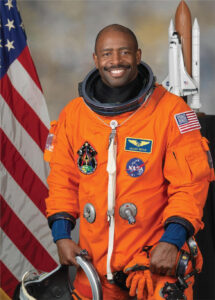
Astronaut Leland D. Melvin, of Virginia, was briefly a wide receiver for the Detroit Lions.
In 1986, Melvin was chosen by the Lions in the 11th round of the NFL Draft to be a wide receiver. He was later released by the team after he pulled his hamstring during training. He earned a bachelor of science in chemistry from the University of Richmond in 1986, and was later selected by NASA in 1998. He served on two flight missions and logged more than 565 hours in space.
More recently, Christina Koch, of Grant Rapids, was an astronaut on NASA’s Artemis II mission in 2026, a 9-day mission to fly around the moon. Koch severed as the mission specialist.
The University of Michigan’s Space Grant Consortium’s maintains a lengthy list of astronauts with their profiles and mission histories. Here are other astronauts with Michigan ties:
Andre Douglas, University of Michigan graduate
Aisha Bowe, Ann Arbor native
Josh Cassada, Albion College graduate
Jeanette Epps, Ford Motor Company
Dominic Antonelli, Detroit native
Andrew Feustel, Lake Orion native
George Zamka, raised in Rochester Hills
Michael Anderson, served in Air Force at Wurtsmith Air Force Base
Michael Bloomfield, Flint native
Brent Jett, Pontiac native
Richard Searfoss, Mount Clemens native
J.M. Linenger, East Detroit native
Daniel Barry, professor at U-M
Ronald McMonagle, Flint native
James Bagian, director U-M Center for Healthcare Engineering and Patient Safety
Winston Scott, Michigan State University graduate
Kenneth Cameron, MSU graduate
David Leetsma, Muskegon native
Brewster Shaw, Cass City native
Anthony England, dean College of Engineering and Computer Science at U-M Dearborn
John Fabian, served in Air Force at Wurtsmith Air Force Base
Jack Lousma, Grand Rapids native
David Scott, U-M graduate
Fred Worden, Jackson native
James Taylor, U-M graduate
James Irwin, U-M graduate
Theodore Freeman, U-M graduate
Karl Henize, U-M graduate
Deke Slayton, served in Air Force at Selfridge Air Force Base
How can I celebrate World Space Week in Michigan?
Here are places to visit to learn more about space science during international World Space Week:
Air Zoo Aerospace & Science Experience in Portage.
Roger B. Chaffee Planetarium in of the Grand Rapids Public Museum.
Planetarium & Dome Theater at University of Michigan’s Museum of Natural History in Ann Arbor.
Keweenaw Dark Sky Park an International Dark Sky Park located near Copper Harbor in the Upper Peninsula.
Keweenaw Rocket Range near Copper Harbor in the Upper Peninsula.
Sloan Museum of Discovery’s 52-foot dome in Flint.
Contact Sarah Moore @ smoore@lsj.com
This article originally appeared on Lansing State Journal: It’s World Space Week. See Michigan’s ties to exploration
Reporting by Sarah Moore, USA TODAY NETWORK / Lansing State Journal
USA TODAY Network via Reuters Connect

It’s World Space Week. See Michigan’s ties to exploration added by admin on
View all posts by admin →