

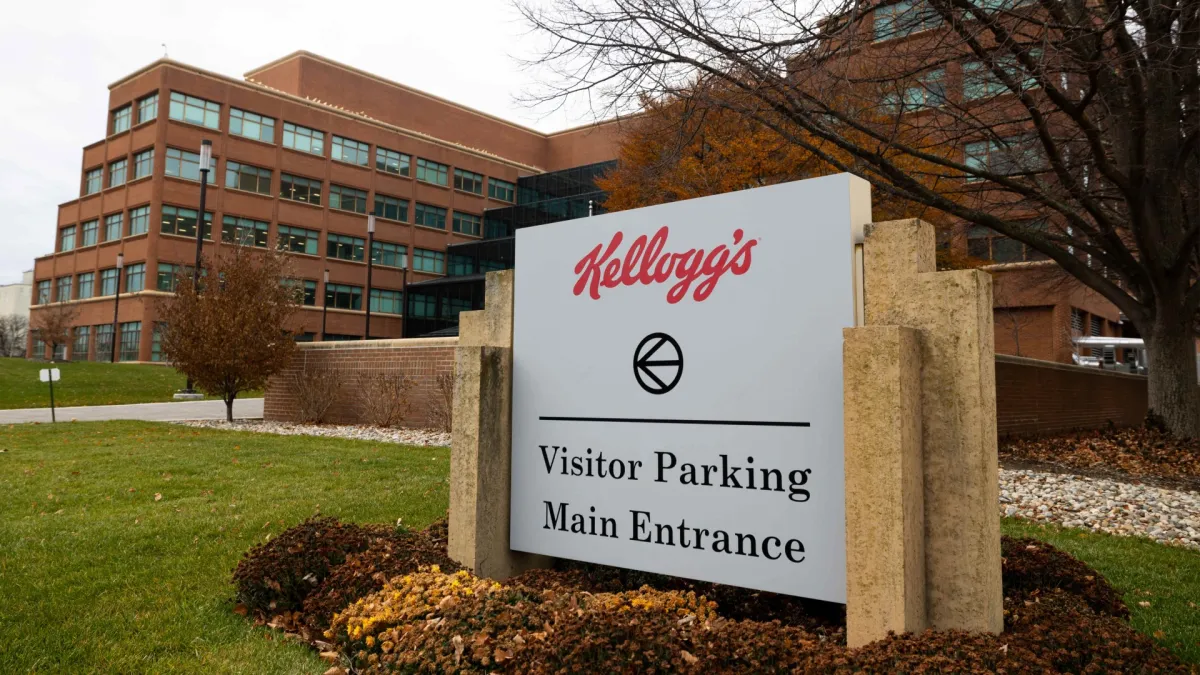
- Candy maker Ferrero finalized its purchase of the WK Kellogg Co. in October and plans to keep its North American cereal headquarters in Battle Creek
- Known as the Cereal City, cereal production has shrunk drastically in Battle Creek over the decades
- City leaders worry whether Ferrero will continue the kind of investment in Battle Creek that Kellogg invested, but remain optimistic
This story is part of the Southwest Michigan Journalism Collaborative’s coverage of equitable community development. SWMJC is a group of 12 regional organizations dedicated to strengthening local journalism. To learn more, visit swmichjournalism.com.
BATTLE CREEK — Six weeks after Italian candymaker Ferrero finalized its purchase of the WK Kellogg Co., the mood at a Battle Creek economic forum was one of cautious optimism.
“We’ve been preparing for change, and we’re going to continue that momentum,” said Joe Sobieralski, head of Battle Creek Unlimited, the area’s economic development agency.
The good news for Battle Creek: Ferrero — the maker of Nutella, Tic Tacs and Ferrero Rocher chocolates — has said it plans to make Battle Creek the headquarters of its North American cereal operations.
“They currently have 850 employees in Battle Creek, and they’re heavily investing in the Battle Creek cereal plant,” Sobieralski told the audience of about 335 at the Nov. 4 event.
Left unsaid: The Ferrero acquisition marks the end of an era for Battle Creek.
For decades, Kellogg has been the region’s dominant entity, a key part of the city’s identity. As a major corporation headquartered in Battle Creek, Kellogg has been more than just a large employer and taxpayer — it also played a significant role in local philanthropy and civic affairs.
RELATED:
- In Battle Creek, Burmese refugees fleeing genocide confront new fears in US
- Battle Creek seeks to right history, remove channel that moved Black residents
- ‘Historic’ Michigan buildings targeted for sale by Trump administration
“The leadership culture of the Battle Creek is the Kellogg Co. and the philanthropic culture is the Kellogg Foundation,” said Michelle Miller-Adams, a political scientist with the Upjohn Institute for Employment Research. “If you need to get something done in Battle Creek, you need either the Kellogg Co. or the Kellogg Foundation to help you with it.”
So what now? Where does Battle Creek go from here?
Sobieralski is framing the Kellogg buyout as good news, potentially offering new opportunities for Battle Creek to increase its role in food manufacturing.
“The glass is half full,” Sobieralski said. “We’re very optimistic.”
Others are less so.
“I feel sorry for Battle Creek,” said Hannah McKinney Apps, an economic professor at Kalamazoo College whose expertise includes economic development.
A quarter century ago, Apps was in the same position as Battle Creek leaders now. She was on the Kalamazoo City Commission when The Upjohn Co., a Kalamazoo-based drugmaker for more than a century, merged with Pharmacia and then was bought by Pfizer Corp.
RELATED: 30 years after Upjohn merger, Kalamazoo area proves its resilience
For an eight-year period, Kalamazoo County experienced round after round of corporate downsizing and layoffs before it finally stabilized.
“It was horrible,” Apps said, adding that Battle Creek doesn’t have some of the same resources as Kalamazoo, where Western Michigan University and two regional hospitals have helped buffer the economic winds.
Cereal City no more?
The breakfast cereal industry was born in Battle Creek, thanks to the Battle Creek Sanatorium, a holistic wellness center affiliated with the Seventh Day Adventists.
C.W. Post was a failed businessman who stayed at the sanatorium to recover from a nervous breakdown. Inspired by the homemade cereals served at the institution, he founded Post Cereals in 1895 to manufacture Grape Nuts and Post Toasties.

In 1906, WK Kellogg — brother of the doctor who oversaw the sanatorium — started his own cereal company, The Kellogg Co., whose first product was Kellogg’s Corn Flakes.
Around the same time, a third cereal manufacturing plant opened in Battle Creek, the Cero-Fruto Co., which was acquired by Ralston Purina in 1927.
Kellogg, Post and Ralston continued to be major Battle Creek employers for decades. Ralston closed its Battle Creek plant in 2017. Post, which was acquired by Philip Morris Co. in 1985 and today is part of Kraft General Foods, still has a Battle Creek plant with about 800 employees.
For the past 40 years, Kellogg was the cereal maker that continued to be headquartered in Battle Creek. The company’s dominant role in civic affairs was underscored by the 1983 merger of Battle Creek city and Battle Creek Township after Kellogg threatened to leave if voters rejected the merger.
“Kellogg’s was the straw that stirred the drink,” said Jim Haadsma, a Battle Creek lawyer who also wa the city’s state representative from 2018 to 2024.
Still, Kellogg has been shrinking its Battle Creek footprint for the past three decades, Haadsma said. In the late 1990s, Kellogg began moving manufacturing operations to Mexico and other plants in the US, laying off more than 1,700 workers in Battle Creek between 1997 and 1999.
In 2023, Kellogg had about 2,000 workers in Battle Creek when the company was split into two. The North American cereal business was renamed the WK Kellogg Co., with the headquarters staying in Battle Creek. The rest of the company, comprising about 82% of Kellogg sales — the global snack business, international cereal and noodles, and frozen foods — became Kellanova, a separate company headquartered in Chicago.
Mars, the international candymaker based in Virginia, announced its buyout of Kellanova last year. That deal is expected to be finalized shortly. In July, Ferrero announced its $3.1 billion acquisition of WK Kellogg, a sale finalized in October.
Kellanova still has about 600 workers in Battle Creek, while WK Kellogg has about 850.
Mars and Ferrero are “great companies,” Sobieralski said. “We’re very excited about these acquisitions and these partnerships to see what’s possible.”
Mars and Ferrero have “done a great job” of portraying their acquisitions as a positive for Battle Creek, Haadsma said. But how it will actually play out remains to be seen.
One concern is corporate philanthropy. As a large company headquartered in Battle Creek, Kellogg was a reliable sponsor of many local nonprofits and civic organizations, such as the Battle Creek Symphony.
“I don’t think that Ferrero and Mars — larger, international companies — are going to have nearly as great of an interest in Battle Creek as did The Kellogg Co.,” Haadsma said.
Diversifying the economy
That said, Haadsma said he generally agrees with Sobieralski that Battle Creek has reason to be optimistic about its future.
One reason: The Fort Custer Industrial Park has been a major success story and currently has more than 80 companies employing almost 13,000 people. The park tenants include Denso, a Japanese-owned auto parts manufacturer with more than 2,500 local workers, making it Calhoun County’s biggest employer.

Another reason for optimism: Adjacent to the industrial park is the Battle Creek Executive Airport, initially built as a military airport as part of Fort Custer and now owned by the city.
“The airport is a massive asset to this community. It has massive potential for economic development activity,” Sobieralski said. “There’s only 100 of these kinds of airports across the nation with this length of runway and this type of land” nearby available for development.
Already, the airport is the home of the Western Michigan University College of Aviation; Duncan Aviation, an airplane maintenance facility; and WACO Aerospace, which manufactures biplanes.
The long-term vision is to develop the airport into “a manufacturing site for large drones, a center for large drone operations, a hub for drone maintenance and repair (and) a location for training drone pilots,” Sobieralski said.
“We have the one-tenth of the pieces” to fulfill that vision, he said. “This is not something that’s going to happen overnight … Five years, you might see some movement, but this is a five-, 10-year-plus project.”
But, he added, “This is a game-changer for not only Battle Creek, but downtown Battle Creek, as well.”
Another potential game-changer? Less than 10 miles from Battle Creek, Ford Motor Co. is building a massive factory in Marshall to build vehicle batteries. The factory is expected to open in 2026 and will employ 1,700 workers.
Meanwhile, downtown Battle Creek also is undergoing revitalization, Sobieralski said, with the recent renovation and reopening of several prominent buildings that were vacant.
That includes the new DoubleTree by Hilton hotel that opened last year next to Kellogg Arena. The hotel replaces the McCamly Plaza, which closed in 2019 and left the city without a downtown business hotel for five years.
Next door to the hotel is The Milton, the city’s tallest building at 19 stories. Constructed as a bank in 1931, the building had been vacant for a decade. It reopened in 2020 after a gut renovation converted it into 85 apartments with commercial space on the ground floor.
Other relatively new downtown businesses include Café Rica, a popular coffee shop; New Holland Brewing, a brewpub; and Record Box, a 1902 building that has been renovated and now houses Handmap Brewery on the first floor and a wedding venue on the third floor.
“If you went back seven years ago and you were here on off hours, you could roll a bowling ball down the streets of downtown Battle Creek and you wouldn’t hit a car or a pedestrian,” Sobieralski said. “We still have a long way to go, but it has totally changed.”
And while The Kellogg Co. is officially no more, Battle Creek is still the headquarters of the WK Kellogg Foundation, the seventh-largest private foundation in the nation and the largest in Michigan.
“They’re a big, big foundation in a very small place,” Miller-Adams said.
Although the foundation funds programs around the world, it retains a keen interest in Battle Creek, and has spent tens of millions on local projects in recent years, including a program to cover college tuition for graduates of Battle Creek Public Schools and helping fund the Battle Creek Innovation Hub, which just opened downtown.
The hub offers classes and workforce training programs through a partnership between Grand Valley State University and Battle Creek Unlimited, and is yet another example of a vacant downtown building that has been repurposed.
The challenges
For all the positive things happening in Battle Creek, there continue to be challenges.
Perhaps the biggest: “We create jobs in this community, but people choose to live elsewhere,“ Sobieralski said.
Indeed, it’s no secret that many executives and other well-paid professionals who work in Battle Creek live in neighboring Kalamazoo County — which is twice the size as Calhoun County, has a much bigger selection of affluent homes and neighborhoods and a much livelier arts and entertainment scene.
“I think Battle Creek has an inferiority complex when it comes to Kalamazoo,” Haadsma said. There’s a perception that “we don’t have as many amenities as Kalamazoo, there’s not as much to do, we don’t have the same quality of parks or schools — although I think in the main, that’s simply not true.”
And it’s not just the competition with Kalamazoo. In deciding to locate the Kellanova headquarters in Chicago, company officials told Battle Creek civic leaders a major reason was talent recruitment: It’s much easier to recruit someone for a job in Chicago than it is in Battle Creek.
“To me, one of the huge challenges Battle Creek has is simply its size,” Miller-Adams said. Some people “want to live in a bigger place than Battle Creek.”
To address that issue, a top priority for Battle Creek Unlimited is “place-making” initiatives — i.e., projects that make Battle Creek a more desirable place to live.
“To create the economic engine that we want,” it requires getting local workers to live in and around Battle Creek, Sobieralski said. “We want to capture some of that disposable income and keep it here.”
That means creating more executive-level housing, as well as affordable housing initiatives; continuing the efforts to create a more vibrant downtown and developing the restaurants, retail and other amenities that draw new residents, Sobieralski said.
Part of that work is not just improving the city and its environs, but publicizing all that Battle Creek has to offer, Haadsma said, adding that’s much more difficult in an era where Battle Creek’s media landscape has shrunk.
“We don’t have a robust newspaper. We don’t have a TV news station here. We don’t have a local radio station,” Haadsma said. “We do have a lot of new opportunities in Battle Creek, but it’s a matter of making individuals aware of what’s going on and that’s more challenging when we just don’t have the communication tools, at least in the traditional media.”
But the fact is, “there are so many reasons to want to live here, not the least of which is affordability. In relation to Kalamazoo, this is a more affordable place to live,” Haadsma said. “It’s a place with very friendly neighbors, excellent schools. It’s an excellent place to raise a family.”
Sobieralski agreed. “This community is moving forward,” he said. “We have to embrace change.”
Business Watch
Covering the intersection of business and policy, and informing Michigan employers and workers on the long road back from coronavirus.
About Business Watch
Subscribe
Share tips and questions with Bridge Business Editor Paula Gardner
Thanks to our Business Watch sponsors.
Support Bridge’s nonprofit civic journalism. Donate today.
This must be the credit given on each article: Put at bottom of each article in small print
“This story was originally published by Bridge Michigan (bridgemi.com), a nonprofit and nonpartisan news organization. To get regular coverage from Bridge Michigan, sign up for a free Bridge Michigan newsletter here (https://bit.ly/BridgeMichiganNewsletter).”
Use photos as well and credit photos. Simply copy and paste name and put: Photo Credit: John Doe

Battle Creek faces life after Cereal City following Kellogg sale added by Tribune on
View all posts by Tribune →